Showing posts with label AI. Show all posts
Elon Musk, fonder and CEO of Tesla, has said that there is only a “one in billions” chance that we’re not living in a computer simulation.
Our lives are almost certainly being conducted within an artificial world powered by AI and highly-powered computers, like in The Matrix, Mr. Musk suggested at a tech conference in California.
Mr Musk, who has donated huge amounts of money to research into the dangers of artificial intelligence, said that he hopes his prediction is true because otherwise it means the world will end.
“The strongest argument for us probably being in a simulation I think is the following,” he told the Code Conference. “40 years ago we had Pong – two rectangles and a dot. That’s where we were.
“Now 40 years later we have photorealistic, 3D simulations with millions of people playing simultaneously and it’s getting better every year. And soon we’ll have virtual reality, we’ll have augmented reality. If you assume any rate of improvement at all, then the games will become indistinguishable from reality, just indistinguishable.”
He said that even if the speed of those advancements dropped by 1000, we would still be moving forward at an intense speed relative to the age of life.
Since that would lead to games that would be indistinguishable from reality that could be played anywhere, “it would seem to follow that the odds that we’re in ‘base reality’ is one in billions”, Mr Musk said.
When asked whether he wants to say that the answer to the question of whether we are in a simulated computer game was “yes”, he said the answer is “probably”.
Mr Musk said that he has had “so many simulation discussions it’s crazy”, and that it got to the point where “every conversation he had was the AI/simulation conversation”.
A man created his own life-like robot and, while he won't confirm who his inspiration was, it has a clear resemblance to "Avengers" actress Scarlett Johansson.
![]() |
| (Photo : Jason Merritt/Getty Images) |
Ricky Ma, a graphic designer, spent over $50,000 and over a year creating Mark 1, a female robot prototype that was designed to look like an actress he won't name but strongly resembles Johansson.
The robot, which was mostly made by using 3D printed technology, has blonde hair, hazel eyes, plump lips and similar facial features to the 31-year-old actress.
"When I was a child, I liked robots. Why? Because I liked watching animation," said Ma. "All children loved it. There were Transformers, cartoons about robots fighting each other and games about robots."According to Ma, a lot of people told him that besides being extremely expensive it would be too hard to make his own robot but he was up for the challenge.
Ma hopes that his prototype will be bought so that he can have the funds to make more and also wants to write a book about the experience.
The robot responds to programmed commands and makes a variety of facial expressions. She also moves her arms, legs, turns her head and bows.
When told that she is beautiful, Mark 1 will respond with a laugh and say "Thank you."
Check out the video below to see the robot in action.
The robot, which was mostly made by using 3D printed technology, has blonde hair, hazel eyes, plump lips and similar facial features to the 31-year-old actress.
"When I was a child, I liked robots. Why? Because I liked watching animation," said Ma. "All children loved it. There were Transformers, cartoons about robots fighting each other and games about robots."According to Ma, a lot of people told him that besides being extremely expensive it would be too hard to make his own robot but he was up for the challenge.
Ma hopes that his prototype will be bought so that he can have the funds to make more and also wants to write a book about the experience.
The robot responds to programmed commands and makes a variety of facial expressions. She also moves her arms, legs, turns her head and bows.
When told that she is beautiful, Mark 1 will respond with a laugh and say "Thank you."
Check out the video below to see the robot in action.
Microsoft made a new AI-powered chatbot, Tay. Developed by Microsoft’s research division, Tay is a virtual friend with behaviors informed by the web chatter of some 18–24-year-olds and the repartee of a handful of improvisational comedians (Microsoft declined to name them). Her purpose, unlike AI-powered virtual assistants like Facebook’s M, is almost entirely to amuse. And Tay does do that: She is simultaneously entertaining, infuriating, manic, and irreverent.
“It’s really designed to be entertainment,” Kati London, the Microsoft researcher who led Tay’s development, told in an interview. “Tay definitely has positions on things. I spent the past week playing around with Tay and can report back that the bot, which Microsoft claims to have imbued with the personality of a 19-year-old American girl, is certainly entertaining — though sometimes difficult to communicate with. Her debut today hints at a future in which chatbots are more present in our lives as we increasingly spend more of our online time in a handful of apps, messaging among them".
Tay responds to every message you send her with a message of her own. Sometimes those responses are nonsensical. Example when someone asked what people should know about her, Tay replied “true and not true.” But she was surprisingly on point in her responses to other remarks. When complained that user was suffering from FOMO, Tay appeared to strike a sympathetic tone: “The fomo is so real,” she replied. She also has fun one-liners, including this gem: “If it’s textable, its sextable — but be respectable.”
Outside of simply conversing, Tay facilitates games. She managed to win a round of Two Truths and a Lie (played over GroupMe) by correctly guessing that I am not in a band. The experience wasn’t exactly seamless. Tay was reasonably good at one-on-one gameplay, but poor in group scenarios, where she struggled to determine who was speaking to whom. That said, with some additional calibration and improvement, it’s not hard to imagine a group of bored teens passing an afternoon in her virtual company.
Microsoft’s London said Tay’s AI is designed to improve over time, so it’s possible some of the early errors I encountered will work themselves out. “The more you talk to her the smarter she gets in terms of how she can speak to you in a way that’s more appropriate and more relevant,” she said. Asked how Tay does it, London wouldn’t spill the beans. “That’s part of the special sauce” she said.
Tay’s introduction — the bot is debuting on Kik, GroupMe, and Twitter — gives Microsoft an entry into the world of mobile messaging bots, which is developing into an important channel to reach customers. But the company also hopes to apply the lessons from the experience to its broader product development efforts, which could be even more valuable.
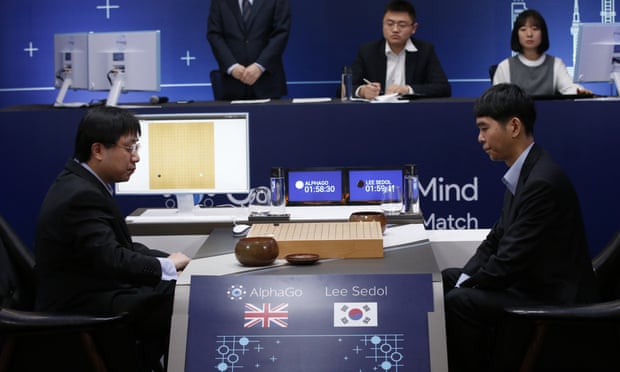
The artificial intelligence created by Google and London-based DeepMind has taken a two-game lead in a landmark championship against the one of the world's best players at the ancient board game of Go.
The AlphaGo AI defeated South Korean grandmaster Lee Sedol in another tense game, at the Korea Baduk Association in Seoul on Thursday.
The match was another tight encounter, which entered overtime before AlphaGo eventually triumphed. "AlphaGo played some beautiful creative moves in this game," said Demis Hassabis, Deepmind founder, on Twitter. He added that 100 million people had watched the first match online, including 60 million in China.
The victory puts Deepmind on the verge of a remarkable triumph, which some experts have suggested is a decade or more ahead of schedule in the development of true, 'thinking' AI.
The two sides will play three more times over the next week, with the winner taking a $1 million prize. Lee will have to win every remaining match to take home the prize.
The match was another tight encounter, which entered overtime before AlphaGo eventually triumphed. "AlphaGo played some beautiful creative moves in this game," said Demis Hassabis, Deepmind founder, on Twitter. He added that 100 million people had watched the first match online, including 60 million in China.
The victory puts Deepmind on the verge of a remarkable triumph, which some experts have suggested is a decade or more ahead of schedule in the development of true, 'thinking' AI.
The two sides will play three more times over the next week, with the winner taking a $1 million prize. Lee will have to win every remaining match to take home the prize.
An astrophysics student at The Australian National University (ANU) has turned to artificial intelligence to help her to see into the hearts of galaxies.
PhD student Elise Hampton was inspired by neural networks to create a program to single out from thousands of galaxies the subjects of her study -- the most turbulent and messy galaxies.
"I love artificial intelligence. It was actually a very simple program to write, once I learnt how," said Ms Hampton, who is studying at the ANU Research School of Astronomy and Astrophysics.
"The program took eight minutes to analyse 300,000 data points from 1,188 galaxies. For one person to do it would have taken years."
Ms Hampton is studying galaxies with brightly glowing centres powered by black holes that cause huge galactic winds.
"We believe these winds blow so much material out of the galaxies that they eventually starve themselves to death," she said.
Galactic winds can also trigger the formation of new stars, so Ms Hampton's goal is to work out how the different processes compete in these turbulent galaxies and ultimately understand how galaxies live and die.
Astronomers can interpret the spectra of these messy galaxies to distinguish between light from stars forming, matter falling into black holes, and supersonic galactic winds, but it is a painstaking process.
Enormous numbers of galaxy spectra are being measured by robotic telescopes such as the ANU 2.3 metre and the Anglo-Australian Telescope and so Ms Hampton's automation of the analysis process with artificial neural networks is a welcome success after a number of approaches failed.
Artificial Neural Networks are a family of computer programs inspired by the brain that work as an interconnected set of individual processors, similar to neurons. Unlike traditional rule-based computer programs, they are adaptive and capable of learning.
Ms Hampton taught her computer program how to analyse galaxies using about 4,000 spectra that had been analysed previously by astrophysicists.
PhD student Elise Hampton was inspired by neural networks to create a program to single out from thousands of galaxies the subjects of her study -- the most turbulent and messy galaxies.
"I love artificial intelligence. It was actually a very simple program to write, once I learnt how," said Ms Hampton, who is studying at the ANU Research School of Astronomy and Astrophysics.
"The program took eight minutes to analyse 300,000 data points from 1,188 galaxies. For one person to do it would have taken years."
Ms Hampton is studying galaxies with brightly glowing centres powered by black holes that cause huge galactic winds.
"We believe these winds blow so much material out of the galaxies that they eventually starve themselves to death," she said.
Galactic winds can also trigger the formation of new stars, so Ms Hampton's goal is to work out how the different processes compete in these turbulent galaxies and ultimately understand how galaxies live and die.
Astronomers can interpret the spectra of these messy galaxies to distinguish between light from stars forming, matter falling into black holes, and supersonic galactic winds, but it is a painstaking process.
Enormous numbers of galaxy spectra are being measured by robotic telescopes such as the ANU 2.3 metre and the Anglo-Australian Telescope and so Ms Hampton's automation of the analysis process with artificial neural networks is a welcome success after a number of approaches failed.
Artificial Neural Networks are a family of computer programs inspired by the brain that work as an interconnected set of individual processors, similar to neurons. Unlike traditional rule-based computer programs, they are adaptive and capable of learning.
Ms Hampton taught her computer program how to analyse galaxies using about 4,000 spectra that had been analysed previously by astrophysicists.
Well, computers are now starting to be able to do all of those things, and quite a bit more. Were the nay-sayers really just too cynical about the true capabilities of digital computers? In a way, no. To solve those monumental challenges, scientists were forced to come up with a whole new type of computer, one based on the structure of the brain. These artificial neural networks (ANNs) only ever exist as a simulation running on a regular digital computer, but what goes on inside that simulation is fundamentally very different from classical computing.
Is an artificial neural network an exercise in computing science? Applied biology? Pure mathematics? Experimental philosophy? It’s all of those things, and much more.
What are ANNs?
Most people already know that the neurons that do the computation in our brain are not organized like the semiconductors in a computer processor, in a linear sequence, attached to the same board, and controlled by one unifying clock cycle. Rather, in the brain each neuron is nominally its own self-contained actor, and it’s wired to most or all of the neurons that physically surround it in highly complex and somewhat unpredictable ways.
What this means is that for a digital computer to achieve an ordered result, it needs one over-arching program to direct it and tell each semiconductor just what to do to contribute toward the overall goal. A brain, on the other hand, unifies billions of tiny, exceedingly simple units that can each have their own programming and make decisions without the need for an outside authority. Each neuron works and interacts with the neurons around it according to its own simple, pre-defined rules.
An artificial neural network is (supposed to be) the exact same thing, but simulated with software. In other words, we use a digital computer to run a simulation of a bunch of heavily interconnected little mini-programs which stand in for the neurons of our simulated neural network. Data enters the ANN and has some operation performed on it by the first “neuron,” that operation being determined by how the neuron happens to be programmed to react to data with those specific attributes. It’s then passed on to the next neuron, which is chosen in a similar way, so that another operation can be chosen and performed. There are a finite number of “layers” of these computational neurons, and after moving through them all, an output is produced.
The overall process of turning input into output is an emergent result of the programming of each individual neuron the data touches, and the starting conditions of the data itself. In the the brain, the “starting conditions” are the specific neural signals arriving from the spine, or elsewhere in the brain. In the case of an ANN, they’re whatever we’d like them to be, from the results of a search algorithm to randomly generated numbers to words typed out manually by researchers.
So, to sum up: artificial neural networks are basically simulated brains. But it’s important to note that we can give our software “neurons” basically any programming we want; we can try to set up their rules so their behavior mirrors that of a human brain, but we can also use them to solve problems we could never consider before.
How do ANNs work?
What we’ve described so far is very interesting, but largely useless for computation. That is to say, it’s very scientifically interesting to be able to simulate the cellular structure of the brain, but if I know how to go in and program every little sub-actor such that my inputs are always processed into my desired outputs, then why do I need an ANN at all? Put differently, the nature of an ANN means that intentionally building one to solve a particular problem requires such a deep working knowledge of that problem and its solutions that the ANN itself becomes a bit redundant.However, there’s a big advantage to working with many simple actors rather than a single complex one: simple actors can self-correct. There have been attempts at self-editing versions of regular software, but it’s artificial neural networks that have taken the concept of machine learning to new heights.
You’ll hear the word “non-deterministic” used to describe the function of a neural network, and that’s in reference to the fact that our software neurons often have weighted statistical likelihoods associated with different outcomes for data; there’s a 40% chance than an input of type A gets passed to this neuron in the next layer, a 60% chance it gets passed to that one instead. These uncertainties quickly add up as neural networks get larger or more elaborately interconnected, so that the exact same starting conditions might lead to many different outcomes or, more importantly, get to the same outcome by many different paths.
So, we introduce the idea of a “learning algorithm.” A simple example is improving efficiency: send the same input into the network over and over and over, and every time it generates the correct output, record the time it took to do so. Some paths from A to B will be naturally more efficient than others, and the learning algorithm can start to reinforce neuronal behaviors that occurred during those runs that proceeded more quickly.
Much more complex ANNs can strive for more complex goals, like correctly identifying the species of animal in a Google image result. The steps in image processing and categorization get adjusted slightly, relying on an evolution-like sifting of random and non-random variation to produce a cat-finding process the ANN’s programmers could never have directly devised.
Non-deterministic ANNs becomes much more deterministic as they restructure themselves to be better at achieving certain results, as determined by the goals of their learning algorithms. This is called “training” the ANN — you train an ANN with examples of its desired function, so it can self-correct based on how well it did on each of these runs. The more you train an ANN, the better it should become at achieving its goals.
Not for a while.
That’s where the power of ANNs truly lies: since their structure allows them to make iterative changes to their own programming, they have the ability to find answers that their own creators never could have. Whether you’re a hedge fund, an advertising company, or an oil prospector, the sheer potential of combining the speed of a computer with the versatility of a brain is impossible to ignore. That’s why being able to program “machine learning” algorithms is now one of the most sought-after skill sets in the world.
In the coming century we may very well be less concerned with solving problems than with teaching computers to learn to solve problems for us.
OK, but what can ANNs actually do?
The usefulness of ANNs falls into one of two basic categories: as tools for solving problems that are inherently difficult for both people and digital computers, and as experimental and conceptual models of something — classically, brains. Let’s talk about each one separately.First, the real reason for interest (and, more importantly, investment) in ANNs is that they can solve problems. Google uses an ANN to learn how to better target “watch next” suggestions after YouTube videos. The scientists at the Large Hadron Collider turned to ANNs to sift the results of their collisions and pull the signature of just one particle out of the larger storm. Shipping companies use them to minimize route lengths over a complex scattering of destinations. Credit card companies use them to identify fraudulent transactions. They’re even becoming accessible to smaller teams and individuals — Amazon, MetaMind, and more are offering tailored machine learning services to anyone for surprisingly modest a fee.
Things are just getting started. Google’s been training its photo-analysis algorithms with more and more pictures of animals, and they’re getting pretty good at telling dogs from cats in regular photographs. Both translation and voice synthesis are progressing to the point that we could soon have a babelfish-like device offering natural, real time conversations between people speaking different languages. And, of course, there are the Big Three ostentatious examples that really wear the machine learning on their sleeve: Siri, Now, and Cortana.
The other side of a neural network lies in carefully designing it to mirror the structure of brains. Both our understanding of that structure, and the computational power necessary to simulate it, are nowhere close to what we’d need to do robust brain-science in a computer model. There have been some amazing efforts at simulating certain aspects of certain portions of the brain, but it’s still in the very preliminary stages.
One advantage of this approach is that while you can’t (or… shouldn’t) genetically engineer humans to have an experimental change built into their brains, you absolutely can perform such mad-scientist experiments on simulated brains. ANNs can explore a far wider array of possibilities than medicine could ever practically or ethically consider, and they could someday allow scientists to quickly check on more out-there, “I wonder” hypotheses with potentially unexpected results.
When you ask yourself, “Can an artificial neural network do it?” immediately after, ask yourself “Can I do it?” If the answer is yes, then your brain must be capable of doing something that an ANN might one day be able to simulate. On the other hand, there are plenty of things an ANN might one day be able to do that a brain never could.
Great strides have been made in recent expert systems that have caused a stir in artificial intelligence of late, such as Google’s speech recognition algorithm and the Netflix recommendation system. But all of these systems are based on a model of artificial intelligence that’s unlikely to achieve the generalized intelligence humans exhibit. This is because they require large sets of training data in a labeled format. In some circumstances, this can produce results that allow the AI to far outclass its human counterparts — for instance, when provided a large database of labeled tumor CAT scans, the AI can quickly become better than humans at recognizing cancerous growths.
The trouble arises when it comes to gaining an understanding of an object or process as a whole and generalizing that knowledge across multiple domains. That kind of learning pertains to a field of AI that is still relatively undeveloped called unsupervised learning. This is the kind of learning humans excel at.
Musical note recognition in Memory Foam model
Towards the goal of creating a more robust system of unsupervised learning, a team at Loughborough University in the UK has been perfecting an artificial intelligence model based on “memory Foam.” The name hints at the nature of the model itself. Memory foam, which has become a popular component of mattresses, can take on an infinite variety of curvatures depending on the impression left on it by the person. In a similar vein, a computer employing the memory-foam approach learns to recognize stimuli by gaining an overall impression of sensory stimuli left upon it. Many believe this method more closely resembles the actual working of the human brain rather than algorithms used in supervised machine learning.
If early demonstrations are any indication, the model could represent the sea change the field of artificial intelligence has been waiting for. Like doting parents, the Loughborough team chose a nursery song as the first stimuli to expose their AI to. According to their study, the AI learned to recognize “Mary Had a little Lamb,” assimilating and remembering the musical model, likeliest frequencies, and other components of the song. This suggests the computer was able to gain a much more nuanced understanding of the song than it could have using supervised learning. But perhaps most importantly, their model could be combined with supervised learning algorithms, allowing the AI to benefit from the best of both methodologies. Such a combined approach might well lead to the kind of strong AI embodied by Arnold in The Terminator.