Showing posts with label Social media. Show all posts
Comedy Premiere League (CPL), One of Shemaroo’s popular social media campaign that became the talk of the town recently got recognised by CMO Asia at an event that was graced by the presence of some of the most renowned brands.
Shemaroo Entertainmentwon the “National Awards for Excellence in Digital & Social Media Marketing 2016” for “Best Use of Twitter”.
Hiren Gada, Director, Shemaroo Entertainment shared his thoughts on the occasion, “We are glad that our efforts have been recognised by the industry. We constantly have been working to connect with our audience on as many platforms as possible and address their need of entertainment with through innovative packaging.”
The campaign was initiated around Cricket and was named CPL - Comedy Premiere League. Shemaroo Premiere League’s 1st edition showcased clash of two Superstars – Akshay Kumar & Salman Khan.
CPL is a great platform for both the fan bases to cheer and support their favorite stars. Each team had 11 players and each of the player from the team played his inning with his comical video that was uploaded on YouTube and shared on Twitter.
So in all, 2 videos were uploaded each day, one from each of the two teams. All that the fans had to do was to Tweet, Retweet, Favourite and like the YouTube video to support their favourite team. The contest was held on Twitter from 14th April’16 to 24th April’16.
Every Retweet would help participant score 4 runs and every Favourite help them earn 2 runs for their favourite stars video. 6 runs would be counted once the video link was liked on Youtube. These 6 runs would add up to the team’s score and not to any individual participant.
Participants scored 1 run every time they tweet using our Hashtags #AkshayKeKhiladi and #SalmanKeDabangg. The video link of the stars would be tweeted with the Hashtag of the team.
CPL not only populated more than 46,897 tweets leading to a reach of over 55,063,405 but also mentions went up by 1000% percent on Shemaroo with a total of 21,241 mentions on the handle CMO Asia, a body that isdedicated to high level knowledge Exchange through Leadership & Networking amongst senior CMOs and brand decision makers across industry segments.
Facebook has become so much a part of our life now. I have few statistics about Facebook users. Worldwide, there are over 1.65 billion monthly active Facebook users (MAUs) which is a 15 percent increase year over year. There are 1.51 billion mobile active users (MAU) for March 2016. (Source: Facebook as of 4/27/16)
One can easily throw a stone and hit a Facebook user. All these stats have proved that we have been spending a considerable amount of time in Facebook. You may feel, what’s wrong if you use Facebook frequently as a means of entertainment. There is nothing wrong unless otherwise these Facebook activities starts interfering with your daily life and becomes detrimental to your daily functional activities. It has even got an unofficial condition worldwide called as Facebook Addiction Disorder (FAD).But Are you a Facebook addict?
With the advent of technologies, it has now become accessible more than ever. This simply supplements your addiction to Facebook and brings everything to your fingertips. Use of Facebook as a means of communication and connectivity with the ones you care about is good. But it shouldn’t lead to the point where your offline social life gets replaced by social life on Facebook.
People are over obsessed with Facebook fame like waiting eagerly and thinking a lot about the responses after updating a status or profile picture in the Facebook page.
Apart from Fame, people are also busy in Facebook messaging, sharing photos, commenting and liking other posts just for a better appeal on Facebook. All you do is just pretend to be something you are not in real life when you compromise your real world happening.
If you are thinking a lot over your updates, just beware it is a sign of being an addict.
Sharing their location (which is a major drawback with the proliferation of smartphones) this intriguing thing is keeping the users’ privacy at stick, even though they know it.
In a Psychological point of view, Lot of activities that we do in Facebook portrays that we are trying to influence the way people see us, to get people to like us.
The use of Facebook has increased rapidly. It occurs more regularly among younger than older users. Also studies have proved that people who are anxious and socially insecure use Facebook and other social medias more those with lower score on those traits. It is probably because who are anxious find it easier to communicate through these social media than face-to-face.
Checking Facebook status often whenever possible, over sharing of photos, overly concerned with Facebook image, spending hours and hours in browsing through Facebook every day, mad about increasing your friends list, compromising real social life, loads of games addiction are all signs of Facebook addiction.
But it’s not a big deal to avoid these things, like use Facebook whenever necessary and make it purposeful. Put FB away for a while, go out and experience the world. Some may still look into Facebook through their smartphones when they are out. Just look out.. We have a beautiful world waiting for us. Enjoy it. You will realize how much more wonderful the world is than to stare at your Facebook wall all day. That’s when change can begin. Make sure Facebook isn’t the first thing or the last thing of your day.
![]() |
| Are You Facebook Addict |
- Five new profiles are created every second. (Source: ALLFacebook 2012)
- There are 83 million fake profiles
- Photo uploads total 300 million per day. (Source: Gizmodo)
- Every 60 seconds on Facebook: 510 comments are posted, 293,000 statuses are updated, and 136,000 photos are uploaded. (Source: The Social Skinny)
- 50% of 18-24 year-olds go on Facebook when they wake up. (Source: The Social Skinny)
One can easily throw a stone and hit a Facebook user. All these stats have proved that we have been spending a considerable amount of time in Facebook. You may feel, what’s wrong if you use Facebook frequently as a means of entertainment. There is nothing wrong unless otherwise these Facebook activities starts interfering with your daily life and becomes detrimental to your daily functional activities. It has even got an unofficial condition worldwide called as Facebook Addiction Disorder (FAD).But Are you a Facebook addict?
With the advent of technologies, it has now become accessible more than ever. This simply supplements your addiction to Facebook and brings everything to your fingertips. Use of Facebook as a means of communication and connectivity with the ones you care about is good. But it shouldn’t lead to the point where your offline social life gets replaced by social life on Facebook.
People are over obsessed with Facebook fame like waiting eagerly and thinking a lot about the responses after updating a status or profile picture in the Facebook page.
Apart from Fame, people are also busy in Facebook messaging, sharing photos, commenting and liking other posts just for a better appeal on Facebook. All you do is just pretend to be something you are not in real life when you compromise your real world happening.
If you are thinking a lot over your updates, just beware it is a sign of being an addict.
![]() |
| Facebook Addiction : Quick Stats |
In a Psychological point of view, Lot of activities that we do in Facebook portrays that we are trying to influence the way people see us, to get people to like us.
The use of Facebook has increased rapidly. It occurs more regularly among younger than older users. Also studies have proved that people who are anxious and socially insecure use Facebook and other social medias more those with lower score on those traits. It is probably because who are anxious find it easier to communicate through these social media than face-to-face.
Checking Facebook status often whenever possible, over sharing of photos, overly concerned with Facebook image, spending hours and hours in browsing through Facebook every day, mad about increasing your friends list, compromising real social life, loads of games addiction are all signs of Facebook addiction.
But it’s not a big deal to avoid these things, like use Facebook whenever necessary and make it purposeful. Put FB away for a while, go out and experience the world. Some may still look into Facebook through their smartphones when they are out. Just look out.. We have a beautiful world waiting for us. Enjoy it. You will realize how much more wonderful the world is than to stare at your Facebook wall all day. That’s when change can begin. Make sure Facebook isn’t the first thing or the last thing of your day.
Never let technology to rule you. Let you be the one to rule the world with technology.
Anyway Like our Facebook Page and Stay update about Tech News Around World.
Facebook, the largest social networking site, rewarded a 10-year-old boy with $10,000 for discovering a bug that allows to delete other people's Instagram comments.
Boy is the youngest person yet to receive a reward from Facebook's bug bounty program. Facebook, has paid more than $4.3 million to more than 800 researchers around the world since the program began five years ago.

Boy was identified by Finnish newspaper Iltalehti only by his first name, Jani. He informed "I wanted to see if Instagram's comment field could stand malicious code. Turns out it couldn't."
Facebook said the glitch was fixed in February and the reward was paid in March.
Jani informed he learned coding from Youtube videos and found a way to delete user comments from Instagram accounts.
He said he was thinking about a career in data security, but for now his plans include buying a new bike and a football with his reward money.
Dear Kashmiri friends (the ones who don’t like India),
I write in this open forum because something terrible is happening in the Kashmir Valley. The recent events at NIT Srinagar only brought the situation to national attention. Some students burst crackers when India lost the T20 semi-final. Many students were beaten for raising the Indian flag. Thereafter, bloody clashes have broken out in north Kashmir.
I understand that there is little pro-India sentiment amongst locals in the Kashmir Valley. Many would rather the Valley be on its own, some wouldn’t even mind being with Pakistan. I will not judge you. Despite being a patriotic Indian, i won’t hold it against you if you hate India. You must and do have your reasons for it.
However, allow me to present another point of view. Allow me to tell you how your future will be best, on a practical basis, if the Kashmir Valley integrates and assimilates with India. This is not an emotional, political or historical argument. It is simply more rational for people in the Kashmir Valley who seek a better future to do it with India.
Sure, the experts will jump on me now. Experts who have made the Kashmir problem their fiefdom. However, if the problem were indeed solved, how will these people stay relevant? Hence, they always attack any solution with their elitist ‘this is too complicated an issue’ stance. They love complicated. It gives them another conference to attend. You suffer with complicated, as the problem never gets solved.
The issue is complicated for sure. For those who don’t know the Kashmir issue, here it is in a nutshell. India became independent. Princely states were assimilated. Jammu & Kashmir didn’t accede. Pakistan attacked Kashmir, took half of it (and still controls it). Kashmir’s ruler called India for help. In return for help J&K became part of India, but with riders.
J&K would have its own constitution, have more political independence than other states, while the Centre would handle defence, foreign affairs and communications. In theory, it was a good solution, a sort of one country, two systems approach. In reality, it never worked.
Instead of two parents as planned, J&K became nobody’s child and an orphan. Pakistan took advantage and used the common factor of Islam to start a militant movement. The Indian army tried to control it. However, it is difficult to control terrorism that co-exists with a civilian population (case in point: even the world’s superpowers appear unable to control Islamic State).
Hence the Indian army, and India, only got a bad name in the Valley. Thus the ‘we hate India’ slogans and perennially unsolved Kashmir problem.
The question is, what is a Kashmiri youth to do now? First, it is important for everyone, not just Kashmiris, to understand the area and people involved. The J&K map we see in Indian textbooks is far from what exists on the ground. Half of what we see in the map is taken over by Pakistan and China. Even though India may claim it, unless we are okay with heavy civilian casualties (which we are not), we will never get it.
Hence, let’s just focus on the half under Indian control, which can be divided into three areas: Ladakh, Jammu and the Valley. Most of the trouble is in the Kashmir Valley. This is only around 7% of the area Indians see on the J&K map and approximates the size of Manipur. In terms of people it is 7 million, roughly the population of Chennai.
The terrain is rugged and the area is completely landlocked. Even if we were to indulge the argument that India is a terrible country and so Kashmir Valley should be on its own, can you really build a sustainable country out of it? It will be a tiny stub in a troubled area, abused by both India and Pakistan. With no real economy and extreme dependence on its giant neighbours, it risks becoming a cesspool of terrorism, drugs and smuggling.
There is also a risk of its being taken over by fundamentalist Islamic forces. It is unlikely anybody from outside would invest money in such a dangerous place. There would be no jobs and no safety. Would you want to live there? Ditto if it joins Pakistan. India is seen as a major emerging market economy. Pakistan is not even seen as a real economy.
Another issue is women’s rights. Half of the Valley’s people are women. Given the hold of
fundamentalist Islam, their rights would be curbed under both the independence and Pakistan options. This half of the population would be better off with India. Or do what women want not matter?
If you are Kashmiri and care for Kashmir, the best thing you can do is to integrate with India. Your population size is small, only 7 million. It is not unthinkable to unite them and create a group of people that talks real business with the Indian government. Your local politician won’t talk assimilation, as he or she would rather hold more power than a typical state government in India. However, for you, the youth, the best bet is to make the Valley truly part of India.
The rest of India should not ask for the removal of Article 370. The 7 million people in the Valley should. Kashmiri Pandits who were made to leave the Valley need to be brought back. Terrorism is no solution, nor revenge and retribution for Indian atrocities. Terrorism is only going to harm people in the Valley most.
So, it is youth in the Valley who have to now start a movement to really solve this problem. Get rid of Article 370. It is not empowering Kashmir. It is only empowering your local politicians, who frankly can do nothing for you without Indian integration.
Don’t blame the Indian army. It has the tough job of weeding out terrorists from a civilian population which is almost impossible without collateral damage, terrible as that might be. However, blame those truly responsible, the Pakistani army, the local leaders who exploited the situation and the experts who did nothing for you.
Don’t burst crackers when India loses. Don’t feel good when India fails.
Because if India fails, you will fail too.
Jai Hind. Jai Kashmir.
WhatsApp could have accidentally entered into troubled waters here in India by enabling its end-to-end encryption for all. The new security feature by WhatsApp is not what is required by the Indian telecom rules and WhatsApp could face a ban, if the rules are not adhered to. But not yet.
After Apple’s problems with the FBI over unlocking an iPhone for retrieving encrypted data splat all over the internet, tech giants such as Apple and Google backed Apple’s decision on refraining to help the FBI to unlock the device. The major reason for Apple not helping the FBI was user’s data privacy and security norms. But the FBI managed to crack open the phone without any help from Apple, which is not a big question if the user’s data is even secure and private anymore.
In India, companies need to follow the country’s rules and adhere to specific types of encryption, which WhatsApp does not currently use. WhatsApp’s end-to-end encryption on its chat service means that WhatsApp or anyone else won’t be able to crack open its contents. Only the sender and the recipient are able to read the encrypted data. WhatsApp uses a 256-bit key for encryption of all chat messages, which is only known to the sender and the recipient.
Why is it not possible for WhatsApp to help decrypt users’ messages? "No one can see inside that message. Not cybercriminals. Not hackers. Not oppressive regimes. Not even us," WhatsApp founders Jan Koum and Brian Acton wrote on their blog.
However, as for the Indian rules, online services are only permitted to use up to 40-bit encryption. If they need to use higher encryption standards, they need to seek permission from the government, and the way WhatsApp is setup, it seems a bit too difficult to obtain the same. In order to get the required permissions and green flags from the Indian Government, WhatsApp needs to submit the keys, which sadly, they too actually don’t have.
Hence, indirectly, all those who are currently using the updated WhatsApp app in India are actually using it illegally, says the report.
A report by The Independent that the Indian government has not yet decided whether they will take any action on the issue and deal with WhatsApp to come to a conclusion.
However, according to the Indian encryption rules, OTT services, such as WhatsApp, do not require encryption standards like telecom operators do. Telecom service providers and internet service providers in India require a license from the DoT to provide encrypted services in India. These include internet telephony and chat services and a usage of up to 40-bit encryptions, only after depositing the decryption keys to the Telecom Authority. Since WhatsApp, Skype, Viber and such services are (over-The-Top) OTT-based and not telecom operations, they are not yet regulated in the country as they do not come under the encryption requirement laws.
The TRAI had released an OTT consultation paper back in 2015, but are yet to issue any such regulations in the matter. In the absence of such regulations, OTT services with such encryptions are presently free to operate legally in the country. However, things could change, citing lack of decryption keys and possibility of illegal activity with terrorist groups and alike on such OTT services.
In other countries, such as France, Skype was made to register with a telecom service provider in order to operate with the encryption standards it holds in place. Similarly, many other countries, including China, Germany and a few others, have also put regulatory systems in place. OTT services are well regulated in countries overseas.
Firstpost mentions Asheeta Regidi, an Indian cyber law specialist, stating, ‘WhatsApp, being an intermediary, is expected to comply with directions to intercept, monitor and decrypt information issued under Section 69 of the Information Technology Act, 2000. Complying with such a direction will now be impossible for WhatsApp in view of its end-to-end encryption. Even before the introduction of this, since WhatsApp is not a company based in India, it may have been able to refuse to comply with such directions. In fact, compliance by such companies in regard to data requests from the Indian government has been reported to be very low.’
The Independent further reported that countries like India are currently looking to pass new policies on the new encryption standards. But it is presently unclear whether these new policies will bring new requirements on WhatsApp.
The big question now is that, will India allow WhatsApp to continue in India or will it enforce a new OTT regulation which will put encrypted services like WhatsApp, Skype, Viber and others into the grey zone?
Do tell us what you think about this story in comment section below... Be brave and Keep Reading
Facebook just announced the biggest changes to its mobile platform in a long time. Its Live video is now one of the prime features on its mobile app and has gone on to replace the message button that occupied the center of the app.
Since its release, the feature has gone on to become one of the more popular ones on the app. With services like Periscope catching fire in no time, Facebook has the rationale to believe it can make its own name, thanks to a global user base to its name.
Visual changes and All
The looks are clearly the more important aspect of any app, and Facebook has done some major work to make livestream the centerpiece of attention, quite literally.
Since its release, the feature has gone on to become one of the more popular ones on the app. With services like Periscope catching fire in no time, Facebook has the rationale to believe it can make its own name, thanks to a global user base to its name.
Visual changes and All
The looks are clearly the more important aspect of any app, and Facebook has done some major work to make livestream the centerpiece of attention, quite literally.
It has added the ability to post Live Reactions to the video as it plays along with the ability to add comments to it, which is important since people are 10 times likelier to comment than on ordinary videos. However, with the new Replay Comments, you would be able to watch the comments chronologically as they appear when you watch the video later.
There will be an option to place a Live Filter on a video, with a set of 5 options initially to customize your stream as it goes. In the future, you’ll also get the ability to draw doodles live.
Live for Groups and Events
You can also now restrict as to who watches a particular video. For instance, in a friend’s birthday, you’ll be able to share the stream with only the people who were on your invite list but couldn’t make it.
The same goes for Groups. An artist can take the audience backstage or inside the studio, though the audience will only be restricted to the authorized group.
You can get to know about the biggest streams of the last 24 hours in a dedicated place, as well as the streams from your favorite people and on the topics you like.
Perhaps the biggest deal is being able to invite your friend to the stream you are currently viewing. Facebook is going ahead and launching a Live Map on desktop where people from 60 countries will be able to share video and see activity in real-time.
You are also likelier to stumble upon livestreams more. For one, you will get relevant results on the search bar. Further, there is a new dedicated search bar under the Live video section of the app.
Going All Out for the Competition
If you have been following the streams of services like Twitter’s Periscope and Snapchat in the past, you would have noticed that a lot of features here have been, well, borrowed.
For example, the live comments and animations that appear along with the video are something pioneered by Meerkat, and subsequently, Periscope, while doodling has been a major part of Snapchat’s forte.
What Facebook does have in its favor is still incredible audience, which is in significant numbers in every major market, apart from China.
What makes live video great, according to Facebook, is its rawness. Since it isn’t prepared-for, it gives the user a clearer and humane look in stories. Also as people watch their idols go on about their lives, it gives them more insights into how things work in other people’s sphere.
In fact, livestream is now such a big thing that companies like Facebook and Twitter are now paying people to get into the action, especially with the latter’s recent signing of live NFL game broadcasts. Facebook is not going to sit back, and is reportedly already in negotiations with the New York Times and Buzzfeed.
But what all this really means is that livestreaming is clearly turning out to be one of the big things out there on social networks and it’s only a matter of when not whether people on our side of the world will start accepting it in their daily lives.
There will be an option to place a Live Filter on a video, with a set of 5 options initially to customize your stream as it goes. In the future, you’ll also get the ability to draw doodles live.
Live for Groups and Events
You can also now restrict as to who watches a particular video. For instance, in a friend’s birthday, you’ll be able to share the stream with only the people who were on your invite list but couldn’t make it.
The same goes for Groups. An artist can take the audience backstage or inside the studio, though the audience will only be restricted to the authorized group.
You can get to know about the biggest streams of the last 24 hours in a dedicated place, as well as the streams from your favorite people and on the topics you like.
Perhaps the biggest deal is being able to invite your friend to the stream you are currently viewing. Facebook is going ahead and launching a Live Map on desktop where people from 60 countries will be able to share video and see activity in real-time.
You are also likelier to stumble upon livestreams more. For one, you will get relevant results on the search bar. Further, there is a new dedicated search bar under the Live video section of the app.
Going All Out for the Competition
If you have been following the streams of services like Twitter’s Periscope and Snapchat in the past, you would have noticed that a lot of features here have been, well, borrowed.
For example, the live comments and animations that appear along with the video are something pioneered by Meerkat, and subsequently, Periscope, while doodling has been a major part of Snapchat’s forte.
What Facebook does have in its favor is still incredible audience, which is in significant numbers in every major market, apart from China.
What makes live video great, according to Facebook, is its rawness. Since it isn’t prepared-for, it gives the user a clearer and humane look in stories. Also as people watch their idols go on about their lives, it gives them more insights into how things work in other people’s sphere.
In fact, livestream is now such a big thing that companies like Facebook and Twitter are now paying people to get into the action, especially with the latter’s recent signing of live NFL game broadcasts. Facebook is not going to sit back, and is reportedly already in negotiations with the New York Times and Buzzfeed.
But what all this really means is that livestreaming is clearly turning out to be one of the big things out there on social networks and it’s only a matter of when not whether people on our side of the world will start accepting it in their daily lives.
Instagram has begun rolling out longer video recording for its iOS and Android app, the company announced.
Users will soon be able to record and post Instagram videos that are as long as 60 seconds.
Instagram has increased the video limit on posts because users have been watching more videos on the service.
"In the last six months, the time people spent watching video increased by more than 40 percent," the company said on its official blog.
Only a small group of users, including verified and unverified accounts, will get first access to the longer video publishing feature.
The feature will be available to everyone "in the coming months."
The company also said in the announcement that it extended the video length because it wanted to deliver flexible and creative ways on how users can watch and create videos on the app.
Lately there have lots of rumors that micro - blogging site twitter was going to extend its 140 words limits to 10,000 world but If you thought you will be able to convey more to your friends and policymakers on Twitter soon, hold on. According to the micro-blogging site, there is still time for you to tweet in 10,000 characters and its original 140-character limit is here to stay.
Appearing on a TV show, Twitter CEO Jack Dorsey said that the 140-character limit is "a beautiful constraint" and that Twitter "will never lose that feeling".
Keep calm and tweet on, Twitter loyalists. The limit is here to stay.
Jack Dorsey, co-founder and chief executive of Twitter, assuaged people's concerns in an interview with NBC's Today show on Friday, confirming that the company will keep tweets at 140 characters.
"It's staying. It's a good constraint for us," Dorsey said in the interview, which took place on the 10th birthday of Twitter. "It allows for of-the-moment brevity."
Dorsey's response — at an economical length of 81 characters — is likely to calm the hard-core base of Twitter supporters who have been vocally resistant to any major changes to the network, home to more than 320 million regular users. For years, those in Twitter's top ranks have been hesitant to make drastic changes to the service for fear of losing some of those most active users.
But as the company's user growth has slowed over the past few years, Twitter has faced mounting pressure from Wall Street to attract more people to the network — a feat that has proved much more difficult than the company's executives have hoped.
Since his return in October to Twitter as its permanent chief executive, Dorsey has made it clear that many of the things employees held sacrosanct about Twitter, including tweet length — were no longer untouchable. Employees were given leeway to experiment on different versions of what the product would look like to make it more intuitive and to increase the likelihood of attracting repeat visitors.
According to Dorsey's comments, it looks like the character limit was one characteristic of Twitter he was not willing to drop. But that does not mean the service will not change in other ways.
Keep calm and tweet on, Twitter loyalists. The limit is here to stay.
Jack Dorsey, co-founder and chief executive of Twitter, assuaged people's concerns in an interview with NBC's Today show on Friday, confirming that the company will keep tweets at 140 characters.
"It's staying. It's a good constraint for us," Dorsey said in the interview, which took place on the 10th birthday of Twitter. "It allows for of-the-moment brevity."
Dorsey's response — at an economical length of 81 characters — is likely to calm the hard-core base of Twitter supporters who have been vocally resistant to any major changes to the network, home to more than 320 million regular users. For years, those in Twitter's top ranks have been hesitant to make drastic changes to the service for fear of losing some of those most active users.
But as the company's user growth has slowed over the past few years, Twitter has faced mounting pressure from Wall Street to attract more people to the network — a feat that has proved much more difficult than the company's executives have hoped.
Since his return in October to Twitter as its permanent chief executive, Dorsey has made it clear that many of the things employees held sacrosanct about Twitter, including tweet length — were no longer untouchable. Employees were given leeway to experiment on different versions of what the product would look like to make it more intuitive and to increase the likelihood of attracting repeat visitors.
According to Dorsey's comments, it looks like the character limit was one characteristic of Twitter he was not willing to drop. But that does not mean the service will not change in other ways.
Facebook said it has paid Rs 4.84 crore to security researchers in India as part of its bug bounty programme, the most paid till date by the world's largest social networking platform.
India, which has over 142 million Facebook users, also holds top rank among 127 countries in terms of researchers contributing to its bug bounty programme, it said in a blog.
"India is home to the largest population of security researchers (205) participating in the Facebook bug bounty programme since its inception in 2011. The country also holds the top spot for most bounties paid (Rs 48.4 million)," Adam Ruddermann, a technical program manager on the Facebook Bug Bounty team, wrote.
Facebook's bug bounty programme has received over 2,400 valid submissions and has awarded more than $4.3 million to 800-plus researchers globally.
Under the programme, researchers get rewarded for reporting security bugs, identifying vulnerabilities in Facebook's services or infrastructure that can create security or privacy risks.
In 2015, Facebook's team classified 102 bug bounty submissions as high impact, an increase of 38 per cent over the previous year.
It received 13,233 total submissions from 5,543 researchers in 127 countries and paid $936,000 to 210 researchers, who submitted a total of 526 valid reports.
The average payout was $1,780. India, Egypt, and Trinidad and Tobago received the highest number of payouts.
"Facebook receives more and more high-impact bugs (related reports) from India each year, reflecting the growing sophistication and technical capabilities of the country's engineering schools and cybersecurity programmes," he said.
Explaining how Facebook calculated the risk and bounties paid to researchers, Ruddermann said the company looks at the potential impact of a bug, what could possibly go wrong, and who would be affected.
"The primary goal of our programme is to protect the people who use Facebook, so bugs that impact end users are the most important to us. We also consider the difficulty of exploiting the vulnerability and what kind of resources or technical skills a successful attack would require," he added.
The amount paid in bounties is generally consistent but can change as the risk landscape evolves, he said.
"We also reserve the option to award researchers more than the base amount if the report itself exhibits a high level of clarity, sophistication, and detail," Ruddermann said.
"India is home to the largest population of security researchers (205) participating in the Facebook bug bounty programme since its inception in 2011. The country also holds the top spot for most bounties paid (Rs 48.4 million)," Adam Ruddermann, a technical program manager on the Facebook Bug Bounty team, wrote.
Facebook's bug bounty programme has received over 2,400 valid submissions and has awarded more than $4.3 million to 800-plus researchers globally.
Under the programme, researchers get rewarded for reporting security bugs, identifying vulnerabilities in Facebook's services or infrastructure that can create security or privacy risks.
In 2015, Facebook's team classified 102 bug bounty submissions as high impact, an increase of 38 per cent over the previous year.
It received 13,233 total submissions from 5,543 researchers in 127 countries and paid $936,000 to 210 researchers, who submitted a total of 526 valid reports.
The average payout was $1,780. India, Egypt, and Trinidad and Tobago received the highest number of payouts.
"Facebook receives more and more high-impact bugs (related reports) from India each year, reflecting the growing sophistication and technical capabilities of the country's engineering schools and cybersecurity programmes," he said.
Explaining how Facebook calculated the risk and bounties paid to researchers, Ruddermann said the company looks at the potential impact of a bug, what could possibly go wrong, and who would be affected.
"The primary goal of our programme is to protect the people who use Facebook, so bugs that impact end users are the most important to us. We also consider the difficulty of exploiting the vulnerability and what kind of resources or technical skills a successful attack would require," he added.
The amount paid in bounties is generally consistent but can change as the risk landscape evolves, he said.
"We also reserve the option to award researchers more than the base amount if the report itself exhibits a high level of clarity, sophistication, and detail," Ruddermann said.
Those days are Gone are the days when cellphones were not easy to afford and people used one for years. After the boost in cellphone market, the handsets became cheaper with a steep rise in their number and the cropping up of numerous cellphone companies. So, people these days change their cellphones frequently (within an year or even less), thanks to the availability of ample number of low-cost smartphones.
However, in this process of changing cellphone, transferring data from the old phone to the new one becomes a daunting task.
WhatsApp Messenger is one of the most popular instant messaging service and is used for both personal and work purposes.
Users end up losing valuable WhatsApp data when they switch from one cellphone to another. Here are few ways to transfer data from one device to another.
iPhone users
iCloud backup: One can securely store WhatsApp content on the iPhone using iCloud backup. All you need to do is go to WhatsApp settings, under the chats section, select chat backup, then click backup.
Now, install WhatsApp on your new phone. When you will confirm the same number used on the old phone, you will get an option to retrieve your chat history. When you accept the option, you will receive all the messages on your new smartphone. Make sure to enable the auto backup feature on your new handset.
Android users
Android users get multiple ways to backup their messages and other content.
External microSD card: Open WhatsApp, go to settings, go to chats and calls. Then tap on backup chats. A backup will be created on the microSD card, which can be used to transfer the data on the new device.
PC: Connect your device to the PC using a USB cable. Go to the phone storage and open the WhatsApp folder. Copy the folder on your PC and eject the device. Now, install WhatsApp on your new smartphone, confirm your old number. The backup will be identified and restored.
Google Drive: Users can store their data to Google Drive, according to WhatsApp. “We recommend connecting your phone to Wi-Fi prior to backing up your chats via Google Drive, as backup files may vary in size and may consume mobile data, causing additional charges,” the company said in a post.
After months of testing, Facebook’s new “Reactions” feature was rolled out last week (Feb. 24) . In addition to the reliably inadequate “Like” button, Facebook’s 1.6 billion worldwide users can now select from emojis signaling “Love,” “Wow,” “Haha,” “Sad,” and “Angry.”
On the surface, these new emoticons would seem to offer Facebook users a chance to expand their emotional vocabulary—as well as potentially offer valuable data to businesses down the line. But in fact the emojis reveal the inherent restrictiveness of Facebook. Human expression is limitless and resists tracking by traditional data mining techniques
Despite the new emojis, Facebook operates by unwritten protocols that largely inhibit users from expressing complex emotions. Just imagine the hell that would break loose if Mark Zuckerberg included in his range of responses emoticons that reflect what Facebook users really think about their friends’ posts. Frustration and jealousy are common reactions. So are feelings of inferiority, boredom, loneliness and contempt.
In private, many of us judge our Facebook friends for coming across as phonies, exhibitionists, self-promoters, and attention junkies. Consider the way you might feel if you noticed that your friend had posted a new, flattering selfie on Facebook. From experience, you might suspect that your friend is feeling low and could use a blast of support from flattering comments. But the you may also feel embarrassed about your friend’s obvious vulnerability, as well as self-conscious about having done the same thing yourself. Nonetheless, the cursor comes down, a shy gavel: Like
.
Of course this kind of complexity is not reflected in the six newly approved emotions available on Facebook. The company has simply formalized the range of emotions most of us feel are safe and appropriate to express on a social network.
Over time, Facebook users have learned to inhibit their emotional lives online. To do otherwise feels too dangerous; we risk expulsion from the tribe. Even if we did express ourselves honestly, unless we have a sensitivity for language as refined as a Romantic poet’s, the odds of our words being misinterpreted are too high. On Facebook, a humorous remark can come across as whiny, mocking or even bitter. People who want to politely disagree can appear in print to be expressing enmity or condescension. Surely by now Facebook knows how contained its users are–it has helped sheriff that containment. That’s why Reactions will not help businesses get a better sense of people’s true responses. It’s simply institutionalized the rules of the game.
These are the same rules that many successful novels follow. In both Facebook and fiction, characters are almost never as they first appear. As people get to know one another over time, their real identities reveal themselves–or not. Is it any coincidence that Facebook’s emoticons resemble the masks of comedy and tragedy used in Ancient Greek theater to disguise the identities of the characters and the chorus?
Ultimately, Facebook’s new Reactions are irrelevant–old news writ in new emoticons. Businesses hoping that the emojis will be a boon for big data will doubtless be disappointed in the long run. And most of us will remain flummoxed about whether—and how—to express ourselves online.
Over time, Facebook users have learned to inhibit their emotional lives online. To do otherwise feels too dangerous; we risk expulsion from the tribe. Even if we did express ourselves honestly, unless we have a sensitivity for language as refined as a Romantic poet’s, the odds of our words being misinterpreted are too high. On Facebook, a humorous remark can come across as whiny, mocking or even bitter. People who want to politely disagree can appear in print to be expressing enmity or condescension. Surely by now Facebook knows how contained its users are–it has helped sheriff that containment. That’s why Reactions will not help businesses get a better sense of people’s true responses. It’s simply institutionalized the rules of the game.
These are the same rules that many successful novels follow. In both Facebook and fiction, characters are almost never as they first appear. As people get to know one another over time, their real identities reveal themselves–or not. Is it any coincidence that Facebook’s emoticons resemble the masks of comedy and tragedy used in Ancient Greek theater to disguise the identities of the characters and the chorus?
Ultimately, Facebook’s new Reactions are irrelevant–old news writ in new emoticons. Businesses hoping that the emojis will be a boon for big data will doubtless be disappointed in the long run. And most of us will remain flummoxed about whether—and how—to express ourselves online.
The feature is rolling out now...
Facebook is rolling out a new feature that lets you set a short, GIF-like looping video as your profile picture, the company announced Wednesday.
The new feature is rolling out slowly, Facebook says, so you might not get it right away. The company also said it’s coming to iPhone users first, so Android owners should sit tight a bit longer.
Facebook is rolling out a new feature that lets you set a short, GIF-like looping video as your profile picture, the company announced Wednesday.
The new feature is rolling out slowly, Facebook says, so you might not get it right away. The company also said it’s coming to iPhone users first, so Android owners should sit tight a bit longer.
Here’s how to set your Facebook profile picture as a video, if you have the feature:
- Open the Facebook app on your iPhone.
- Hit the “More” button in the bottom-right corner of the screen.
- The first thing on the list that appears should be your name. Tap it to go to your profile.
- Tap your current profile picture.
- Here’s the moment of truth. In the menu that appears, you’ll either see the option to “Take a New Profile Video,” or it’ll say “coming soon.” If you’ve got the option, you can go ahead and record a short video to use as your profile video, or upload one you’ve already taken.
And that’s it. We look forward to all the creative ways people use the new feature!
This Is What Your Facebook Profile Looked Like Over the Last 11 Years
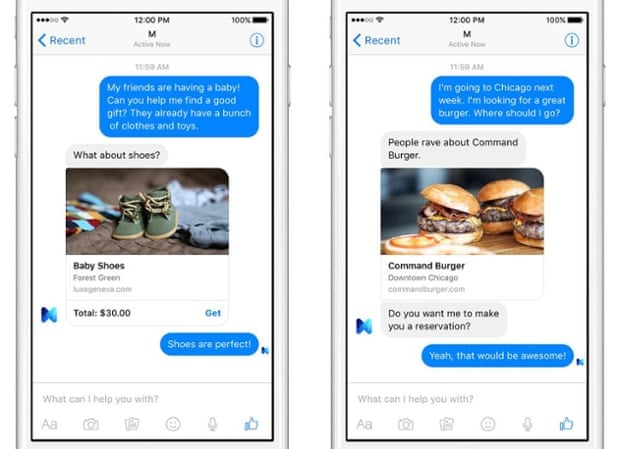
Facebook recently began limited testing of an online personal assistant, called 'M' that uses a combination of human workers and software to answer questions and carry out tasks like ordering food or flowers for a friend, Daily Mail reported."M is a personal digital assistant inside of Messenger that completes tasks and finds information on your behalf. It's powered by artificial intelligence that's trained and supervised by people," a Facebook spokesperson was quoted as saying.Unlike other AI-based services in the market, 'M' can actually complete tasks on your behalf."It can purchase items, get gifts delivered to your loved ones, book restaurants, travel arrangements, appointments and way more," the spokesperson added.Only a few hundred people are believed to have access to the service.To use 'M', users have to tap a small button at the bottom of the Messenger app to send a note.Its software will decode the natural language, ask follow-up questions in the message thread, and send updates as the task is completed.In internal tests, Facebook employees have been using 'M' for several weeks to do everything from organising dinner parties to tracking down an unusual beverage in New Orleans, according to Wired."An engineer went to Paris for a couple days, and his friend asked M to redecorate his desk in a French style," Marcus told the site."Twenty-four hours later, the desk was decorated with a proper napkin, baguette bread, and a beret," Marcus said.'M' learns from human behaviours.
Google loves experimenting with just about everything, including social apps. Some, like Google Plus are launched with announcements and flair, while others are just dropped into the Play store and observed. Taking the latter approach, Google just released an app called Who’s Down, …and it has the one thing we all love: an invite system!
While we wait for our invite code, ahem… let’s take a look at what this app is for. The concept is simple; when you have some free time and want to do something, this app announces your state of tedium and helps make plans with your friends.
Taking the place of a “Hey, anyone wanna grab a movie?” group text or god forbid, a phone call, Who’s Down also lets users specify what kind of things they are actually in the mood for, and a light built-in messenger to solidify plan details.
Signing up currently requires a Google account and an invite code. Attaining said code, means submitting an email and a school name, taking the whole exclusivity and student-first path; an approach made popular in the last decade by numerous apps.
This week in social media, Facebook finally fixed its battery-draining iPhone app. Meanwhile Twitter's CEO gave millions worth of stock to the company's employees and Instagram announced yet another new video app. It's time for Social Media Sunday!
Facebook
Broken iPhone App, Finally Fixed
Facebook's iPhone app has had big issues draining peoples' batteries. On Friday, the social media giant finally released an update to its iOS app promising to solve the problem
Facebook engineering manager Ari Grant explained the main cause of the battery-draining problem with a colorful analogy in a post on his Facebook page (via Wired):
"The first issue we found was a 'CPU spin' in our network code. A CPU spin is like a child in a car asking, 'Are we there yet? Are we there yet? Are we there yet?' with the question not resulting in any progress to reaching the destination. This repeated processing causes our app to use more battery than intended. The version released today has some improvements that should start making this better."
The second issue, according to Grant, involved how the Facebook app was managing audio on iOS devices. "If you leave the Facebook app after watching a video, the audio session sometimes stays open as if the app was playing audio silently," wrote Grant. "This is similar to when you close a music app and want to keep listening to the music while you do other things, except in this case it was unintentional and nothing kept playing. The app isn't actually doing anything while awake in the background, but it does use more battery simply by being awake."
Grant said iOS users would see improvements to battery life in the new update, and promised that he and his team will continue to work on improving the battery usage of the Facebook app.
Facebook Search Expands to All Public Posts
In a new challenge to Google's dominance of search and Twitter's hold on real-time news, Facebook announced the rollout of an expanded Facebook Search, called Search FYI.
Now, according to the company's announcement, Facebook searches for news topics such as "Mets World Series" or "Halloween Costumes" will return results not just from friends and pages you follow, but from the total index of Facebook's over 2 trillion public posts per day. The company is also rolling out improved, personalized search suggestions as you type, in another move that will make Google unhappy.
Right now the expanded search feature is only rolling out on the U.S. English version of Facebook.
Instagram
Introduces Boomerang
Somewhere between a photo and a GIF is Instagram's new video app, called Boomerang.
The Facebook-owned image-sharing network announced the new mini-video app for iOS and Android on Thursday, promising it was a tool that could "transform an ordinary selfie with your friends into a funny video," almost automatically. "Press a button and the app does the rest," said Instagram on its blog.
The app takes bursts of photos and puts them together into a mini-video that can play forward and backwards -- hence the name -- which, of course, you can then share on Instagram.
"Capture a friend jumping off a diving board, defying physics as she flies back and forth through the air...Get that exact moment your friend blows out his birthday candles, then watch them come back to life again and again," Instagram suggested. Whether the "back-and-forth" motion app leads to hilarity or quickly gets old is yet to be seen.
Twitter
CEO Dorsey Gives a Third of His Stock to Employees
After Jack Dorsey's major shakeup at Twitter last week, in which 336 of the company's staff, or eight percent, were laid off, the new CEO of Twitter offered those who remained something quite valuable: a third of the stock he owns in Twitter.
That, according to NPR, amounts to about one percent of Twitter's stock that Dorsey is donated to his employees, which may not sound like much until you know its valuation: a little more than $200 million.
Dorsey tweeted the move on Friday, saying "I'm giving ~1/3rd of my Twitter stock (exaction 1% of the company) to our employee equity pool to reinvest directly in our people." He further explained in a later tweet, "I'd rather have a smaller part of something big than a bigger part of something small. I'm confident we can make Twitter big!"
Monetizing the new 'Moments'
Twitter introduced a new feature called "Moments," at the beginning of October, promising to round up important tweets, articles, and trending photos into convenient category tabs like News, Sports, Entertainment, and Fun.
The company didn't waste a moment finding ways to make money off of the new content discovery feature, announcing to Bloomberg on Friday "Promoted Moments." The advertising channel will be available for a 24-hour period to marketers, launching this weekend with content promoting the new movie "Creed."
Twitter didn't disclose its ad rates or sales process, but it's safe to say it'll be a substantial new revenue stream, since as opposed to single promoted tweets, Moments allows advertisers to incorporate more photos, videos, tweets, and other content to build a comprehensive story around their product.
8 Indians Step Under The Spotlight And Show Everything That Is Wrong With India Today!
Four men and four women were put under the spotlight and were asked a few simple questions about their daily lives. The responses which emerged will make you introspect!TheOxfamIndia with Ufaan.org came together with a social experiment to show the big difference between men and women in India which prevails even today.
Watch this and ask yourself 'Am I in the spotlight?'
The Reserve Bank of India (RBI) will soon allow transfer of money from one online wallet to another. These services are expected to launch from early 2016. The service is being developed in association with the National Payments Corporation of India (NPCI).This transfer of funds from one online wallet to another was mentioned by Infosys co-founder and Former Chairman of the Unique Identification Authority of India (UIDAI), Nandan Nilekani during the ‘WhatsApp moment in finance’ talk that happened in Bengaluru in August.
The talk happened during The Indus Entrepreneurs (TiE) Leapfrog summit, Nilekani said that India was moving towards a cashless transaction mechanism with the emergence of services such as Immediate Payment Service (IMPS), mobile wallets, direct cash and more. He said that IMPS transactions had exceeded money orders within three years of launching, even though money order service was launched back in 1880. He also said that IMPS would overtake debit and credit card payments.Nandan Nilekani also mentioned the Unified Payments Interface (UPI) which would allow interoperability from different bank accounts and wallets. The NPCI had initiated the UPI in February and had released a draft document for the payments architecture.Most of the banks in India have already released their own mobile wallets. In August this year, SBI had announced its own mobile wallet app called SBI Buddy. The app is available on the Google Play Store for free while an iOS version of the app would be released soon. The app can be used by SBI customers as well as non-SBI Customers. ICICI Bank also released a similar e-wallet service called Pockets. Ahmedabad based Zebpay became the first company in India to launch a mobile Bitcoin wallet.In May this year, cyber security firm F-Secure found that cyber attacks on mobile wallets and e-currencies were on the rise. According to the firm, SMSs that send trojans and ransomware attacks grew in the second half of last year. The report also said that the threat was equally posed to Android and iOS platforms.
When I started TecPhlie, One of the problem that I faced initially was how can we automate the process of sharing post on social media platform like Twitter,Facebook and LinkedIn so that our reach can expand. After digging internet a bit, I found a website twitterfeed.com, this website can help you to increase your social presence and save lots of time .All you need to worry about is creating a good content and this tool will take care of rest. Here is step by step to use it:-
STEP 1:
First thing is you need is to create accounts on Facebook,Twitter and LinkedIn so your post can be shared on that account.
STEP 2:
Visit twitterfeed.com and sign up.
STEP 3:
After completing signup process,you will receive a verification mail on your registered email address,flow link present in it.That link will lead you to your account on twitterfeed.
STEP 4:
Create a New feed there,Give your feed a name and enter the Blog feed URL,
Your Blog feed URL looks like : http;//yourblog.blogspot.com/feeds/posts/default .You can configure the rate at which this feed will check your blog for update and posts,also you can put prefix and post fix after twitter posts,you can use this to put your twitter handle,as #FashionBlog or so, under Advance Option.
STEP 5:
Then click on continue to step 2,here you can configure your publication services including Twitter and Facebook.Authenticate your Facebook and twitter Accounts and click on create service.
Once these services are created,click on All Done button. That's it ,now your articles will shared automatically on twitter and Facebook as you publish them on your blog.Happy Blogging !!!
If you still face some issue,then comment it below.We will help you as soon as possible.Meanwhile you can share this post.