ABOUT US

Our development agency is committed to providing you the best service.

OUR TEAM

The awesome people behind our brand ... and their life motto.

  • Radha Roy

    Country Head

    I long for the raised voice, the howl of rage or love.

  • Shruti Das

    GM,India

    Contented with little, yet wishing for much more.

  • Divya Narayan

    Branch Head, Banglore

    If anything is worth doing, it's worth overdoing.

OUR SKILLS

We pride ourselves with strong, flexible and top notch skills.

Marketing

Development 90%
Design 80%
Marketing 70%

Websites

Development 90%
Design 80%
Marketing 70%

PR

Development 90%
Design 80%
Marketing 70%

ACHIEVEMENTS

We help our clients integrate, analyze, and use their data to improve their business.

150

GREAT PROJECTS

300

HAPPY CLIENTS

650

COFFEES DRUNK

1568

FACEBOOK LIKES

STRATEGY & CREATIVITY

Phasellus iaculis dolor nec urna nullam. Vivamus mattis blandit porttitor nullam.

PORTFOLIO

We pride ourselves on bringing a fresh perspective and effective marketing to each project.

Showing posts with label simulation. Show all posts
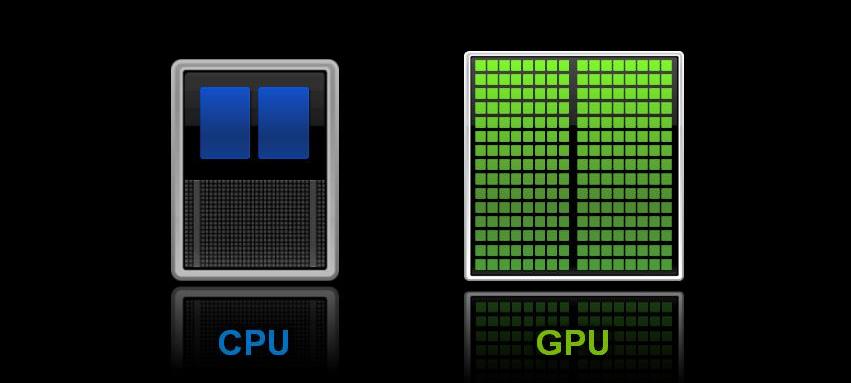
  • GPU vs CPU simplified


    A Graphics Processing Unit (GPU) is a special purpose processor, optimized for calculations commonly (and repeatedly) required for Computer Graphics, particularly SIMD operations.

    A Central Processing Unit (CPU) is a general purpose processor - it can in principle do any computation, but not necessarily in an optimal fashion for any given computation. One can do graphics processing on a CPU - but it likely will not produce the result anywhere nearly as fast as a properly programmed GPU.

    The reasons one has at least one of each in the typical computer these days is:
    • Computers that interact directly with people (i.e. not servers) typically use computer graphics extensively to do so, and the calculations involved are numerous and must be done in Real Time;
    • By having at least one of each, one gains parallelism & greater performance from throughput of the computer system: while your GPU is doing calculations for graphics, your CPU can be doing other non-graphics calculations at the same time.
    • Moore's Law has given us such an embarrassment of riches in silicon chip area and capability at such low prices that it's cheap to add special purpose processors of various types nearly everywhere in a computer system these days – often multiple of them, to achieve better throughput & performance.
    A GPU generally has a large number of slow and weak processors. By weak I mean lower operating frequency, lower number of registers, simpler ALU's etc. GPU's come strapped with lots of memory and generally have high Memory bandwidth to support  the hundreds of small processors that make up the GPU. GPUs are special purpose and can compute vector maths, matrix maths, pixel transforms and rendering jobs about 10-100x faster than the equivalent CPU performance as all these tasks are embarrassingly parallel, although it should be noted that incredibly optimized CPU code can come close to GPU code. 


    However, the amount of work required is not worth the time when GPUs can do the same calculations with significantly less work, and not requiring a programmer with an excellent background in computer architecture.

    A CPU generally has higher operating frequency and is designed for general purpose use. They excel in serial tasks, branching operations and file operations. CPUs, traditionally, have been easier to program and more versatile for general purpose usage. Most office computers have rudimentary GPUs as they don't have to perform such highly parallel/ specialized tasks. But a gaming PC or a workstation PC would generally have a powerful GPU(s).
  • Virtual brushing simulator invented, may help us make better toothbrush

    We take for granted that four out of five dentists agree when it comes to best toothpastes or superior toothbrushes (and that the fifth dentist is just asleep at the wheel, or something), but how much do we really know about what those recommendations are grounded upon? As it turns out, not much.


    We take for granted that four out of five dentists agree when it comes to best toothpastes or superior toothbrushes (and that the fifth dentist is just asleep at the wheel, or something), but how much do we really know about what those recommendations are grounded upon? As it turns out, not much.


    That’s mostly because it’s actually really hard to test the effectiveness of our dental hygiene tools. But now, researchers at the Fraunhofer Institute for Mechanics of Materials IWM in Freiburg, Germany have developed a virtual brushing simulator which may change how we look at our toothbrushes, and may help doctors really test out the effectiveness of our brushing tools.

    The secret, the Institute says, is a novel simulation that actually allows researchers to determine just how much of that nasty film you’re getting off your teeth in the morning and at night. “With our procedure, manufacturers of dental hygiene products can determine the cleaning effectiveness of each individual parameter in a fast, economical and reliable manner,” says IWM scientist Dr. Christian Nutto. “Unlike in real-world experiments, the individual parameters in the simulation can be easily modified — be it the size, shape, and quantity of abrasive particles in a toothpaste, or the material from which they are made, or the shape and elasticity of the bristles.”


    For the first time, researchers will have an efficient way to determine how shape, stiffness, abrasiveness, and even toothpaste viscosity affect our teeth’s enamel, and more importantly, the germs sitting atop our teeth. “We can increase the scope of the experiments far beyond what is possible in real-world testing, and that makes a noticeable difference in the quality of the products,” the Institute claims.


    To conduct their simulations, Nutto says, “We specify the characteristics for the abrasive particles such as density, shape and fill factor.” Then, the team virtually rubs a toothbrush bristle over the tooth, and scientists are able to visualize and quantify “cleaning effectiveness, as well as the aggressiveness of the abrasives against the tooth enamel.” And according to their tests, this new simulation “can precisely predict how the toothpaste and bristles will affect the tooth enamel. At a later stage, it will also be able to predict the effectiveness of the toothpaste and brush at removing the biofilm from teeth.”

    So if you’re looking for a way to test your toothbrush (or want researchers to just do a better job of it), thank the folks at the Fraunhofer Institute and their fancy toothbrush simulator.

  • WHAT WE DO

    We've been developing corporate tailored services for clients for 30 years.

    CONTACT US

    For enquiries you can contact us in several different ways. Contact details are below.

    RUDER FINN INDIA

    • Street :Unit 001A, Tower B, Ground Floor, Global Business Park, MG Road, Gurgaon – 122002, INDIA
    • Person :Radha Roy
    • Phone :91 124 388 2870
    • Country :India
    • Email :royr@ruderfinnasia.com

    Radha Roy.

    Radha Roy Country Head 91 124 388 2870 royr@ruderfinnasia.com Unit 001A, Tower B, Ground Floor, Global Business Park, MG Road, Gurgaon – 122002, INDIA