ABOUT US

Our development agency is committed to providing you the best service.

OUR TEAM

The awesome people behind our brand ... and their life motto.

  • Radha Roy

    Country Head

    I long for the raised voice, the howl of rage or love.

  • Shruti Das

    GM,India

    Contented with little, yet wishing for much more.

  • Divya Narayan

    Branch Head, Banglore

    If anything is worth doing, it's worth overdoing.

OUR SKILLS

We pride ourselves with strong, flexible and top notch skills.

Marketing

Development 90%
Design 80%
Marketing 70%

Websites

Development 90%
Design 80%
Marketing 70%

PR

Development 90%
Design 80%
Marketing 70%

ACHIEVEMENTS

We help our clients integrate, analyze, and use their data to improve their business.

150

GREAT PROJECTS

300

HAPPY CLIENTS

650

COFFEES DRUNK

1568

FACEBOOK LIKES

STRATEGY & CREATIVITY

Phasellus iaculis dolor nec urna nullam. Vivamus mattis blandit porttitor nullam.

PORTFOLIO

We pride ourselves on bringing a fresh perspective and effective marketing to each project.

Showing posts with label Internet. Show all posts
  • 33 MILLION TWITTER ACCOUNTS HACKED


    A hacker claims to be selling 33 million Twitter login credentials, including passwords. Twitter has confirmed and warned the users whose accounts may have affected. It also locked some accounts and sent a password reset request.

    The leak follows a string of high profile Twitter accounts being hacked, including those belonging to Katy Perry, Drake, Mark Zuckerberg and Evan Williams. It's hard to say whether those hacks are related to this latest password  leak. But there is a possibility.


    An analysis of the database by LeakedSource, a breach notification site which received the database from the seller on Wednesday, showed there are in fact over 32 million purported accounts in the database, after duplicates were removed.

    Twitter's former CEO Evan Williams. File photo.
    EVAN WILLIAMS : TWITTER FORMER'S CEO


    LeakedSource said in a blog post that it was unlikely that Twitter was breached, and pointed to malware as the culprit.


    "The explanation for this is that tens of millions of people have become infected by malware, and the malware sent every saved username and password from browsers like Chrome and Firefox back to the hackers from all websites including Twitter," the blog post said.

    The group said it was able to verify the passwords associated with 15 users. LeakedSource shared a portion of the database with me. Two colleagues whose email addresses were in the database were able to verify their password. A third colleague said they had not used the email address found in the database to join Twitter.

    LeakedSource said that the passwords were likely "stolen directly from consumers, therefore they are in plaintext with no encryption or hashing." The groups said it did not believe that Twitter stored data in plain-text at the time the data was taken, thought to be around 2014.

    "These credentials however are real and valid," said the group. "The lesson here? It's not just companies that can be hacked, users need to be careful too."

    As we've seen in recent data breaches, the most common password was "123456," with the third and fourth password being "qwerty" and "password" respectively.

    A Twitter spokesperson said in prepared statement: "We are confident that these usernames and credentials were not obtained by a Twitter data breach -- our systems have not been breached. In fact, we've been working to help keep accounts protected by checking our data against what's been shared from recent other password leaks."

    In a recent tweet, the company also said that it periodically checks its data against recent password leaks to ensure that accounts stay secure.

  • UCWeb launches UC News, developed exclusively for India


                            UCWeb launches UC News, developed exclusively for India 
                                Announces 80 million active users of UC Browser in India
     
    New Delhi, June 6, 2016: UCWeb Inc., a leading mobile internet company and part of Alibaba Mobile Business Group, today announced its strategy for 2016, with the launch of UC News App and an upgraded UC Browser. In a first, UC News is an app launched by the company, meant exclusively for India. UC News is powered by big data technology and is a one-stop source of trending and curated news content covering all popular categories that Indian users can consume on the go. 
    The company, a unit of Alibaba Mobile Business Group, also announced that UC Browser India’s monthly active user base has reached 80 million and continues to grow rapidly. UC Browser is now revamped as a content aggregator and, according to StatCounter, the most used mobile browser in India with over 58% market share as of May 2016. 


    Strategic Shift: From tool to content aggregator
    UC Browser’s usage data shows 73% of its 80 million MAU are tagged as “News Feeds Consumers”. On an average, each UC Browser’s Indian user consumes 6 pieces of news/feeds per day. 

    Commenting on the new strategy, Kenny Ye, General Manager of UCWeb, Alibaba Mobile Business Group said, “Digital content consumption is on the rise and the challenge is how we can customize, curate and present diverse content to users. Content providers face difficulties in distributing content of different formats, while consumers are swamped by an information overload. Our answer to these challenges is to position ourselves as a content aggregator. The newly launched UC News and upgraded UC Browser for India are two contemporary products embedded with the aim of content aggregation.” The revamped UC Browser also features UC Cricket, an in-app, all–in-one cricket content hub. 

    Big data-driven UC News: A smart way to access and consume content 
    UC News offers a platform that brings together both traditional and new media content creators in a single place, and introduces them to millions of Indian users who already enjoy a faster browsing experience on UC Bowser. UC News is an easy to use app, and features a unique and highly user-friendly interface. It is a one-stop source of trending and curated news content covering all the popular categories of news with 20+ featured channels including news, cricket, technology, entertainment, movies, lifestyle, health, humour, etc. 
    UC News tracks and matches the trending keywords on Facebook and Twitter, and decides on the trending topics before recommending them to the user. UC News also allows users to customize content subscription, as they can choose any kind of content they wish to consume. 


    To help make valuable opinions heard, UC News is planning to partner with self-publishers and key opinion leaders in the future for original content.


    Download UC News from Google Play and 9Apps
    UCWeb in India has grown on the strength of its technology and innovation. The data compression algorithms of UC Browser have helped millions of Indians gain access to the internet at faster speeds without premium pricing, thereby making UC Browser a window to the world for many first time mobile phone users. The latest round of service offerings is set to consolidate UCWeb's leadership in India's mobile internet market while helping drive internet accessibility and powering a connected and digital India.
    About UCWeb

    UCWeb Inc. (UCWeb) is a business within Alibaba Group’s mobile business division and a leading provider of mobile internet software and services. Since its inception in 2004, UCWeb's mission has been to provide better mobile internet experience to people around the world. UC Browser, the flagship product of UCWeb, is compatible with all mainstream operating systems and available in 11 languages including English, Russian, Indonesian, and Vietnamese. As of March 2016, UC Browser had reached 400 million Monthly Active Users worldwide. Additional information about UCWeb and UC Browser can be found at www.ucweb.com  

    About Alibaba Mobile Business Group
    Alibaba Mobile Business Group is a leading provider of mobile services and content. Its product portfolio includes mobile browser, mobile search, location-based services, mobile gaming, app store and mobile reader operations. With its technologies and big data, Alibaba Mobile Business Group is committed to bringing about mobile internet innovation and reliability.

  • Tips to Save Internet Data Pack

    When 3G/4G services were coming to India, we thought we might finally have an alternative to cable broadband with high-speeds and reliable connections. What most users never thought was that even the biggest data plans run out especially if you get very high internet speeds.


    If it’s unlimited, it’s throttled and you don’t get the full potential of you 3G/4G connection. We have made a list of tips that will help you save your megabytes and make your internet data limit last longer.

    Get Opera Max for Going Online

    If you want to save data, Opera Max Data Manager is a must. It can handle data savings single-handedly. Opera Max provides system wide data compression so that data can be saved while all the apps using mobile data in the foreground as well as the background connect to the internet. The creators of Opera Max built this tool based on the Turbo-mode in the Opera Browser. All data communications go through the Opera servers and get compressed to save data. Opera Max promises over 50 percent data savings for common apps.


    Opera Max comes with advanced data management tools too. Users can select which apps can use the internet, blacklisting apps to save more data. For example, if you have a package plan that gives you free WhatsApp, you can blacklist all other apps and use WhatsApp without worrying that other apps will cost you money by connecting to the internet automatically. Data management is very easy, once you turn on Opera Max over mobile data, you get details to which apps uses how much data and disable their internet access accordingly. You can activate data compression over Wifi too. A permanent notification lets you view your data usage and savings in real-time.


    Onavo Extend has iOS users covered

    Onavo is similar to Opera Max but comes with iOS support. It may not be as well-known as Opera Max but it can get the task done. It allows users to measure and save data just like Opera with a greater focus on control over apps’ internet usage. Onavo also employs advanced data caching to reduce data usage.

    Enable Data Compression in Google Chrome

    If you have an Android phone, there is a very high probability you are using Google Chrome browser. Yet, most people would be unaware that Chrome has a built-in data saving feature that needs to be enabled manually.


    According to Google, you can save about 50 percent in data consumption by utilizing this feature. The user won’t even feel the difference in web experience. In fact, browsing over mobile data might even get faster. The way this works is, all your data passes through the Google servers, gets compressed and sent to your device.

    To activate the feature, tap on the 3-dot menu button and go to Settings. Click on Data Saver and toggle the option in the top right corner and you’re done. This will help you save data when you are browsing using Chrome.

    Restrict Background Data

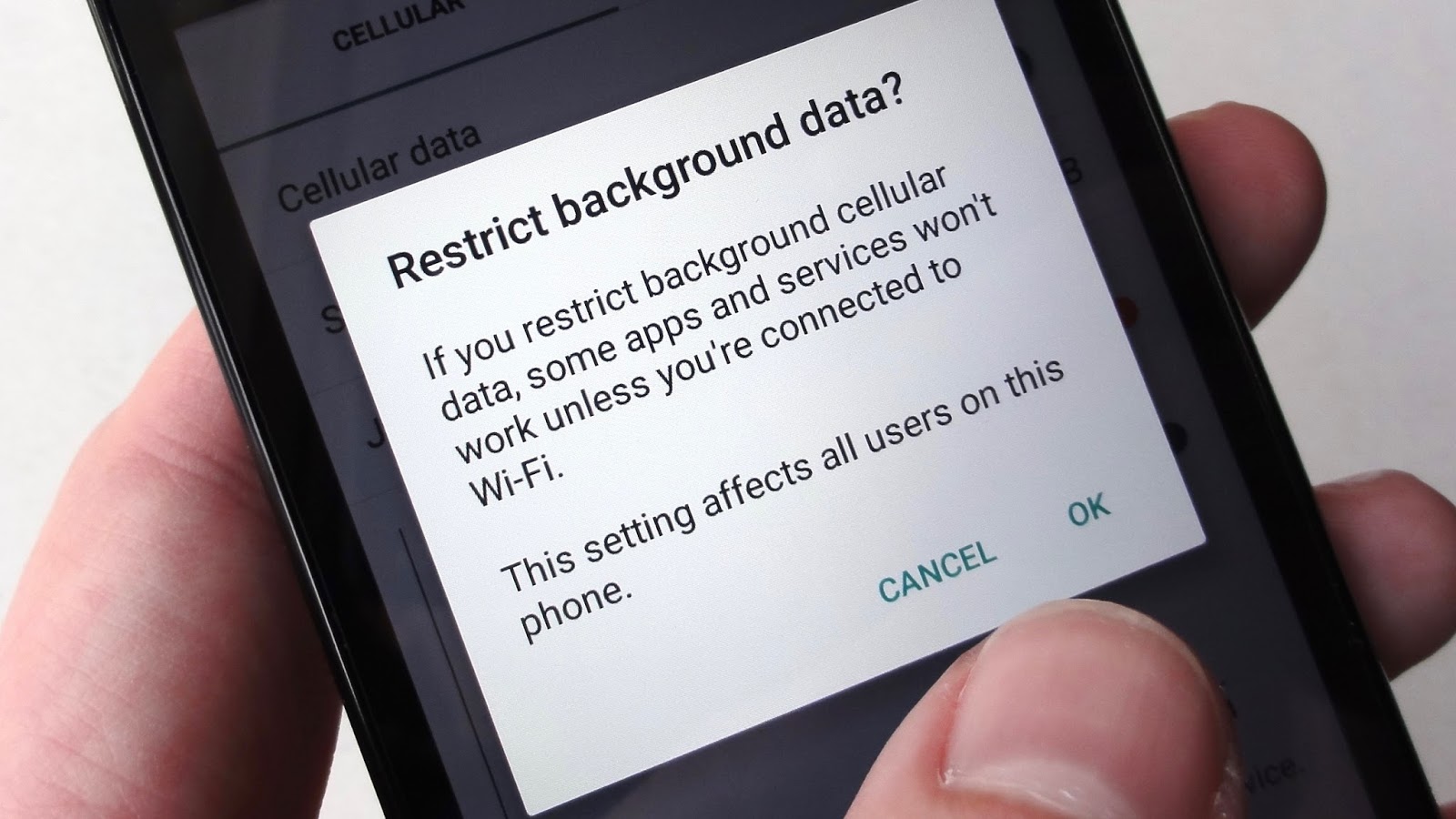
    When you aren’t using mobile data, some apps continue to use it in the background. Social networking apps, messaging apps and other real-time info apps keep using data in the background. Even the Android OS services keep connecting to the internet using your precious mobile data.


    To prevent this from happening, you can go to Settings > Data Usage and select the apps you want to restrict manually. In the stats, you will also get information on how much data each app is using in the foreground and how much of it gets used up in the background. The process isn’t as simple and easy as Opera Max but it’s an alternative to get the detailed stats and restrict data usage.

    If you want to go the extreme route, you can disable background data usage altogether but keep in mind that you won’t get any real-time notifications.

    Set the Play Store to Update Apps Over Wi-Fi Only

    The heading pretty much explains what we mean here. Most users keep getting app updates over mobile data, using your precious data without your permission. Huge amounts of data gets wasted on continuous updates.

    To save data, go to Play Store and open the side menu. Go to Settings and select “Auto-Update apps” button and check (tick) “Auto-Update apps over WiFi only”.

    If you don’t get access to WiFi, you can still update apps manually by opening the Play Store and starting the update process by going to the My Apps section.

    Go Deep Into Sync Settings to Save Some Data

    Everybody wants to get instant email notifications and get their info synced with all the accounts they have signed-in on their Android smartphone. The first thing you can do is to manually turn on and turn off the sync service.

    The next thing is to go to Settings > Accounts and have a look at all your accounts that use the sync services. There are some services that you never use but they keep syncing and using data. For example, when you select a Google account, you will sync enabled for App data, Calendar, Chrome, Contacts, Docs, Drive, Gmail, Google Fit, Opinion Rewards, Photos, Play Music, Google+, and even more stuff. Most users don’t use half of these services so it’s best to disable sync for the useless services.

    You can do the same thing for other accounts as well.

    Streaming is the Enemy of Mobile Data

    Streaming videos, music, looking at high quality images and GIFs burns through your data before you can realise it. Unless you have a very big data package, you must keep an eye on your data usage (Opera Max can help with that too).

    Limit you data streaming since avoiding it must be impossible for most people. Another thing you can do is set the video or sound quality to a bit lower. This will help reduce data consumption.

    When Going Outside WiFi range, Cache Data

    Some apps clean cache to save space. It does clean up space but the cached data reduces data consumption by huge amounts. Browser and other internet oriented apps need cache to make them load faster and save on data.

    Some apps allow local storage, like the Google Maps (and some other map apps), Play Music and Google Translate. Some apps can download the data you need which can be done while using a WiFi connection. You can stream or load the content that you might need before you leave your house. That content will get cached and save you some money on your internet usage.

    Wrap up

    We hope our list of tips will help you save a lot of data and make better use of those packages that only allow you to get connected with only a certain few apps at cheaper costs. These tips certainly won’t hinder your smartphone without internet but they will make it use less data. Besides what is a smartphone without an internet connection?

    If you have any other tips, suggestion or questions, ask them in the comments below.

  • Why Should you use Ad-Block

    Websites that detect ad-blockers to stop their users from reading webpages could be illegal under European law.Ad blockers are completely legal, but the detection of an ad blocker by using a script is technically illegal.


    In recent days, Ad blocking extensions have gained a lot of attraction among the internet users especially among the online gamers. Now it is getting its heat in the smartphones too. Few apps like Purify and Crystal has also gained popularity among the users. Ad blocking has both practical and ethical considerations. But the real question is should you really use ad block? 

    If using such blockers is an issue or is it really beneficial? To answer these questions let us take a closer look at what Ad blockers really do, what they mean to you and for the company….

    What is an Ad Blocker?

    Ad blocking or ad filtering is removing or altering advertising content in a webpage / app. Advertising can exist in a variety of forms including pictures, animations, embedded audio/video, text, pop-up windows and can employ auto-play of audio and video. These software or extensions help us avoid the unwanted ads that appear on the screen of a webpage or an app.

    What the Ad blockers do?

    #1 Adblock being the number 1 ad blocker in the market does block all the advertisements on all web pages like Facebook, YouTube and every website. This works on all browsers like Google Chrome, Safari, Mozilla Firefox, and Opera which is downloaded as an extensions. 

    So it automatically starts working as soon as the browser is opened. When needed it can be turned off on a specific page manually. So far, Ad block has crossed 200 million downloads and there are lot more similar software available on the internet and they are also on the peak downloads.


    What it means to the companies? is it good for them?

    All the websites you are viewing are primarily funded / sourced by those advertisers. A lot of Internet businesses that we use and rely on every day, use a so-called freemium model. You pay nothing for an app, but in turn, you're giving your data and/or your eyeballs to advertisers.  And investors at internet companies say advertising is their huge market.

    So when we block the ads completely, we block the main source of revenue for companies.

    But on the contrary, practical considerations for the users !!!

    We see ads on every page, mini ad, micro ad and more. Some might be useful like so many webpages use data analytics to track our search and show us ads related to our search. But this is just happens in 1 out of 10. Most of the time ads are very annoying and offensive too, at this time ad blockers play a major role. Not only can you use them to block offensive material, Rickrolls, and other unpleasant things, studies have also proved that they can also block malicious software. 

    People are in a situation to block the ads to get rid of those tricky malicious. It is in the company’s hands to choose what type of ads to be published in their sites so as to ensure their growth as well as the people’s satisfaction. 

    A recent global research on ad blocking conducted in the year 2015, reveals the following facts
    • There are now 198 million active ad-block users around the world. 
    • Blocking rate is found to be highest among Firefox users (17.81%), followed by Safari (11.30%) and Chrome (10.06%). Explorer averages at 3.86%
    • Mobile blocking is gaining popularity: Android shows a 2.24% blocking rate, and iOS 1.33%
    What We feel 

    Ads on the web can be all kinds of annoying, but some people prefer not to block every internet ad they see, after all, it is how most web make their money, and are able to keep pumping out content for free. Even if you don't block ads, though, it may be worthwhile to install an ad blocker (like Adblock Plus for Firefox), if only for its malware-blocking powers.

    To have a WIN – WIN situation, web page must be designed in such a way the ads are useful and they must ensure that they are not compelling and annoying.

    Have you installed ad-block, how much time and data it have saved for you.. do tell us in comment section below.
  • North Korea blocks Facebook, Twitter and Youtube


    North Korea has announced that it is blocking Facebook, YouTube, Twitter and South Korean websites in a move underscoring its concern with the spread of online information. 

    An announcement by ministry of posts and telecommunications was posted this week at the country's main mobile service provider, Koryolink, and other places serving internet users. 

    Very few North Koreans have internet access. Typically they can see only a sealed-off, government-sanctioned intranet.


  • Six April Fool Prank That Shock Internet This Year

    Internet dwellers beware! April 1st isn’t a safe day, whether you spend your time online or offline. On this day, you simply cannot take anything at face value, especially news that seems too good to be true. Whether its social media, YouTube or a reliable news site, you just can’t be sure today.

    We have made a list of some of the funniest pranks today. The list may change as the day progresses and more pranks are made public. So keep coming back for more funny updates from today.
     
    Samsung Smart Trousers
    Samsung is a leading tech innovator. And this time, the innovation has come to…trousers. These smart trousers come with Wi-Fly and are clever enough to alert you via your mobile phone to lower your fly (zipper). The trousers come with built-in pressure sensors that can get you to move if you have been sitting for a long time.


    There’s more. It has a system that detects when your waist is a bit too tight and locks the fridge. The Internet of Trousers can also measure your heart rate and blood pressure to remind you to keep your pants on when the surroundings get a bit hot and heavy. Don’t worry, this feature can also be turned off when required.

    Honda Emoji Number Plate
    Honda has chosen to bring an innovation to how cars are officially identified. The company has revealed the world’s first emoji number plate. Younger buyers and teens can express themselves with more than mere number and letters. This invention will also help the driver express their anger by just pointing towards an emoji instead of rolling down the mirror and saying ******* (you know what).


    Honda Civic Type-R was chosen to be the first car to demonstrate this. Licensing agencies are in talks with Honda on bringing the new solution to the market.
    Sony Proton Pack

    Sony Proton Pack
    Want a Ghostbuster like Proton Pack? Sony has made one for those who dreamed of getting their hands on one. Sony explains that there are additional features in the pack compared to the normal Proton Pack.


    It’s said to have “Superconducting temperatures are maintained by a liquid helium reservoir, and an active cryocooler ensures that operational time vastly exceeds that available from a cryogen dewar alone”. 


    On top of all that, it’ll come with a Sony Cyber-Shot RX camera, Short Throw 4K projector and Stamina battery mode.

    Google for Socks


    A long faced problem is the sudden “absence” of socks from their usual place just when you are about to leave your house. Google has teamed up with some Australian retailers to come with Bluetooth-enabled socks. These socks are searchable and come with a smartphone app as well. An Android app has been confirmed while the iOS version is still under development.


    Google’s blog post says “We’re teaming up with retailers across Australia to launch a new range of Searchable Socks — to organise the world’s undergarments and make them universally findable. These new bluetooth-enabled socks are fitted with thin LTE beacons that wrap around the top of your lower calf, just like the coloured stripes you’d see on traditional socks. If you can’t find one sock, you can press the beacon on its pair and let the Google Search app on your phone pinpoint its whereabouts.”
     
    WaterPik Shower Belt
    This international shower company has developed a solution to the slipping problem in the bathroom. We don’t need to explain anything else, you can just watch the video and learn what the new product brings.


    I-Dodge

    Firebox has just released I-Dodge. This innovation will enable you to pass by pedestrians and cross roads while you take stroll with your head down in your phone. 


    The smartphone case will alert those who come nearby with flashing lights. The gadget costs only £50.


  • India have slowest Internet Speed in Asia : Reports

    In a shocking news, South Korea had the highest average connection speed in Asia-Pacific at 26.7 Mbps, while India had the lowest at 2.8 Mbps. Such news for India is very disheartening especially for PM Modi’s Digital India campaign.

    The average page load time for a broadband connection in India was found to be 3.9 seconds and for mobile 6.India had the slowest average connection speed in the Asia region in the last quarter of 2015, at 2.8 megabits per second, according to Akamai's State of the Internet report.

    According to the report, the global average connection speed rose 8.6% to 5.6 Mbps from the third quarter, and rose 23% on a year-on-year basis.The global average peak connection speed rose 1% from the third quarter,32.5 Mbps. In Asia Pacific, South Korea had the highest average connection speed in at 26.7 Mbps, while India had the lowest at 2.8 Mbps.

    Similarly, Singapore held the top spot for average peak connection speed at 135.7 Mbps, while India had the lowest average peak connection speed at 21.2 Mbps.The average page load time for a broadband connection in India was found to be 3.9 seconds and for mobile 6.9 seconds, the report found. Average page load time is the average time it takes a web page to load, from the time a user clicks a link to the page and for it to completely load in the browser.

    India has been among the countries with the slowest Internet connection speeds in the past according to Akamai's report. In Q4 of 2015 also, it stood at 115th position in terms of average connection speed.
  • Record : 57Gbps data transfer rate achieved on fiber-optic cables

    Scientists send data at a record 57Gbps through fiber optic lines
    Engineers at the University of Illinois have created record-breaking speeds for fiber-optic data transmission, breaking previous theories that fiber optics have a limit in how much data they can carry. The engineers transmitted 57 gigabits-per-second (Gbps) of error-free data at room temperature.

    Graduate researcher Michael Liu presented the research team’s developments in oxide-VCSEL technology, which underpins fiber-optic communications systems, at the Optical Fiber Communication Conference and Exposition in Anaheim, CA. The research team was led by electrical and computer engineering professor Milton Feng — who is in attendance at the conference — and also included professor emeritus Nick Holonyak Jr. and graduate researcher Curtis Wang.

    The need for a high-speed data transmission infrastructure has increased as big data has gotten bigger with the need for accommodating the ever-growing volume of bits transferred from one place to another.

    “Our big question has always been, how do you make information transmit faster?” Feng said. “There is a lot of data out there, but if your data transmission is not fast enough, you cannot use data that’s been collected; you cannot use upcoming technologies that use large data streams, like virtual reality. The direction toward fiber-optic communication is going to increase, because there’s a higher speed data rate, especially over distance.”

    Feng’s group has been pushing VCSEL technology to higher speeds in recent years. In 2014, it was the first group in the U.S. to achieve error-free data transmission at 40 Gbps.

    What’s more interesting is that the engineers were still able to transmit 50 Gbps speeds at higher temperatures up to 85 degrees Celsius (185 degrees Fahrenheit). This is significant because for data center builders “achieving high speeds at high temperatures is very difficult,” Feng said. However, computing components grow warm over extended operation, as anyone who has worked on an increasingly heated laptop can attest. “That’s why data centers are refrigerated and have cooling systems.”

    He added, “For data centers and for commercial use, you’d like a device not to carry a refrigerator. The device needs to be operational from room temperature all the way up to 85 degrees without spending energy and resources on cooling.”

    Feng hopes that the conference presentations and papers will prove that high-speed operation at high temperatures is scientifically possible and useful for commercial applications.

    “This type of technology is going to be used not only for data centers, but also for airborne, lightweight communications, like in airplanes, because the fiber-optic wires are much lighter than copper wire,” Feng said. Shedding any weight off a plane where possible can help conserve fuel. “We believe this could be very useful for industry. That’s what makes the work so important to us,” he added.
  • Jio to Be Further Delay in 4G Launch – Reports

    Reliance Jio Infocomm is likely to further delay the nationwide launch of its long-awaited 4G network until the end of the year, according to two investment firms.

    Bank of America Merrill Lynch said in a client note that Jio will likely delay its 4G launch until “it is confident of creating a strong first impression, both in terms of network quality and customer experience”, the Economic Times reported. The note said that the delay would make it increasingly difficult to attract high-value customers from rivals unless it cuts data tariffs.
     
     
     Bharti Airtel, Vodaone India and Idea Cellular have aggressively expanded their 4G footprints. Market leader Airtel has launched 4G in 15 regions, while Vodafone India offers 4G service in five service areas and Idea offers it in ten.

    Jio said in early January, after multiple delays over the past ten months, it would officially launch 4G service across the country by early March. The operator reportedly delayed the launch as it had not yet reached its targeted population coverage.

    Bank of America Merrill Lynch noted that a delay until December would allow Jio to offer 4G service in between 60 per cent to 70 per cent of cities and avoid a phased a launch, which would give its rivals an opportunity to “defend their turf”.

    IIFL Institutional Equities also expects Jio to push back the national launch until December, noting that the timing depends on the merger between Reliance Communications (RCom) and Sistema Shyam Teleservices (SSTL), which is waiting for regulatory approval. RCom announced it November it would acquire its smaller rival, which operate under the MTS brand, through a stock swap.

    In January RCom said that it would share its 800MHz spectrum with Jio in 17 regions. RCom also plans to share 800MHz spectrum in the remaining five circles. Spectrum sharing will give RCom access to a wider band of spectrum and Jio’s network to provide faster 4G data services and provide capex and operating costs savings.

    IIFL reckons that Jio will be able to use RCom’s spectrum only towards December since it can share and trade spectrum with Jio only after obtaining alternative 800MHz frequencies through a merger with SSTL, the Times reported.

    America-Merrill Lynch noted a delay would give the 4G handset ecosystem time to mature, since only 15 per cent of smartphones sold in India support VoLTE and the 800MHz band. But it would also give rivals an additional eight months to expand their 4G networks and migrate customer over and make data tariffs more competitive.

    Jio, which now has 25,000 employees, is the first operator to obtain a pan-India unified licence, holding 751.1MHz across the 800MHz, 1.8GHz and 2.3GHz bands in multiple regions, and has invested a reported $15 billion in the rollout.
  • Average Internet Connection Speed Increases By 23 Percent

    New Delhi: The global average internet connection speed increased 23 per cent to 5.6 Mbps in the quarter ended December 2015 compared to the same period of 2014, a report said on Wednesday. to 5.6.

    The report “Fourth Quarter, 2015, State of the Internet Report” was released by Akamai Technologies Inc., a global leader in content delivery network services.
     

    “From a global perspective, the average connection speed increased 8.6 per cent quarter-over-quarter and 23 per cent year-over-year to 5.6 Mbps, while the global average peak connection speed increased 1 per cent QoQ, and increased 21 per cent YoY to 32.5 Mbps,” it said.

    South Korea had the highest average connection speed in the Asia-Pacifi­c region at 26.7 Mbps, while India had the lowest at 2.8 Mbps.

    “This quarter’s (October to December 2015) report shows great YoY growth in average connection speeds and overall broadband adoption,” said David Belson, editor of the report.

    South Korea (95.3 Mbps) and Macao (83.1 Mbps) were the only countries/regions to post double-digit quarterly gains in average peak connection speed at 10 percent and 13 per cent, respectively.

    “This is particularly important as consumer expectations rise and many high-profile events, like the summer games in Rio, will be streamed this year.

    “The progress we are seeing across our key metrics shows that, while there’s still work to be done, more parts of the world are increasingly able to support the delivery of broadcast-quality video content online,” he added.

    The report also showed each of the top 10 countries/regions saw double-digit growth in 25 Mbps broadband adoption except Hong Kong, which posted a 9.8 per cent change quarter-over-quarter. Norway and Denmark saw the greatest yearly gains, the report cited.

    On a global basis, close to 70 per cent of the countries/regions saw a QoQ increase in unique IPv4 address counts in the last three months of 2015, up 10 per cent from the July-September period of 2015.

    The report also pointed out that 43 countries/regions saw IPv4 address counts grow 10 per cent or more in the quarter ended December 2015 while 13 saw counts decline 10 per cent or more compared with the July-September quarter of 2015.

    The report also showed Britain had the fastest average mobile connection speed at 26.8 Mbps with Spain in second place at 14 Mbps. Iran had the lowest average connection speed, at 1.3 Mbps, followed by Vietnam with an average connection speed of 1.8 Mbps.(IANS)
  • How to Choose Better Password

    There's always debate online about which kinds of passwords are really the most secure, but one universal truth always seems to be that you should change your passwords often. The reasoning behind that is presumably if someone gains access to your account they won't be able to get into it for long. So you're effectively constantly changing it to keep those pesky wannabe hackers guessing.

    But apparently the IT department's obsession with changing up our passwords could be all wrong. According to FTC Chief Technologist and Carnegie Mellon computer science professor Lorrie Cranor, research suggests that if you have to change your password all the time you'll put much less effort into picking a secure one.


    She explains her findings from one particular study:
        “[People] tended to create passwords that followed predictable patterns, called ‘transformations,’ such as incrementing a number, changing a letter to similar-looking symbol (for example changing an S to a $), adding or deleting a special character (for example, going from three exclamation points at the end of a password to two), or switching the order of digits or special characters (for example moving the numbers to the beginning instead of the end).”

    Sound familiar? Exactly. That's why changing your password a lot just isn't smart when it comes to security. In fact, Cranor suggests that those who really want to hack into accounts can do so quite easily via offline attacks that guess a large number of passwords. So your constant changing isn't really going to slow them down that much anyway.

    A strong password is your first line of defense against intruders and imposters.

    Never give out your password to anyone.*
    Never give it to friends, even if they’re really good friends. A friend can – maybe even accidentally – pass your password along to others or even become an ex-friend and abuse it.

    Don’t just use one password. It’s possible that someone working at a site where you use that password could pass it on or use it to break into your accounts at other sites.

    Create passwords that are easy to remember but hard for others to guess.
    When possible, use a phrase such as “I started 7th grade at Lincoln Middle School in 2004” and use the initial of each word like this: “Is7gaLMSi#2004.” And make them at least a little different (by adding a couple of unique letters) for each site. On some sites you might even be able to type in the entire phrase.

    Make the password at least 8 characters long. The longer the better. Longer passwords are harder for thieves to crack.

    Include numbers, capital letters and symbols. Consider using a $ instead of an S or a 1 instead of an L, or including an & or % – but note that $1ngle is NOT a good password. Password thieves are onto this. But Mf$J1ravng (short for “My friend Sam Jones is really a very nice guy) is an excellent password.

    Don’t use dictionary words:  If it’s in the dictionary, there is a chance someone will guess it. There’s even software that criminals use that can guess words used in dictionaries.

    Don’t post it in plain sight: This might seem obvious but studies have found that a lot of people post their password on their monitor with a sticky note. Bad idea.  If you must write it down, hide the note somewhere where no one can find it.

    Consider using a password manager.
    Programs or Web services like RoboForm (Windows only) or Lastpass (Windows and Mac) let you create a different very strong password for each of your sites. But you only have to remember the one password to access the program or secure site that stores your passwords for you.

    Consider using multi-factor authentication.
    Many services offer an option to verify your identity if someone logs on to your account from an unrecognized device. The typical method is to send a text or other type of message to a mobile device registered to you with a code you need to type in to verity it’s really you.  In most cases, you will not be required to use this code when logging on from a known device such as your own computer, tablet or phone.

    Don’t fall for “phishing” attacks.
    Be very careful before clicking on a link (even if it appears to be from a legitimate site) asking you to log in, change your password or provide any other personal information. It might be legit or it might be a “phishing” scam where the information you enter goes to a hacker. When in doubt, log on manually by typing what you know to be the site’s URL into your browser window.

    Make sure your devices are secure.
    The best password in the world might not do you any good if someone is looking over your shoulder while you type or if you forget to log out on a cybercafe computer. Malicious software, including “keyboard loggers” that record all of your keystrokes, has been used to steal passwords and other information. To increase security, make sure you’re using up-to-date anti-malware software and that your operating system is up-to-date.

    Use a “password” or fingerprints for your phone too.
    Most phones can be locked so that the only way to use them is to type in a code, typically a string of numbers or maybe a pattern you draw on the screen. Some new phones allow you to register fingerprints, which are quite secure. Sometimes when people with bad intentions find unlocked phones, they use them to steal the owners’ information, make a lot of calls, or send texts that look like they’re coming from the owner. Someone posing as you could send texts that make it look like you’re bullying or harassing someone in your address book with inappropriate images or words.

    * Some parents ask their kids to share their passwords with them.
    This might be OK with young children, but you might want to respect your teen’s privacy and not ask. Also, if you do ask your children for their passwords, make sure they understand that this is a rare exception to the “do not share password” rule.


  • Developers create tool to load webpages 34% faster, may release soon

    A new research by the Massachusetts Institute of Technology’s Computer Science and Artificial Intelligence Lab and Harvard University has developed a tool that will reportedly allow webpages to load up to 34% faster. Named ‘Polaris’, the tool creates a virtual map of all elements that are required to load on a webpage, including all fonts, javascripts and page formatting. 

    Developers create tool to load webpages 34% faster, may release s...

    This then allows for simultaneous downloading of similar content, thereby saving the browser time spent on mapping the objects and downloading them without a specific structure, often leading to redundancy. Polaris, the developers claim, is built in Javascript and can run on almost any functional browser.

    The idea is to create a simplified route for browsers to load pages based on systematic priority. For instance, this is similar to creating a travel route based on shortest travel times, thereby cutting down on repeated routes. The researchers are looking to further work on Polaris to fine tune its operations, but are enthusiastic about opening it to the public for wider opinions. 


    As of now, they have stated that Polaris shows its best results when tried out on websites with very heavy traffic. We wait to see how it really performs in everyday usage, and how much of a difference does it really make.
  • Free Internet Basic in India Analysis

    Mark Zuckerberg's ambitious mission to provide free Internet access to rural India was rejected by the people it was intended to help long before the country's regulators banned it earlier this month.

    Around the country, farmers, laborers and office workers scorned Facebook's offer. Called Free Basics, it provided only limited access to the Internet through a suite of websites and services that, unsurprisingly, included Facebook. They felt the limited service didn't follow the open nature of the Internet, where all sites and online destinations should be equally accessible, so they organized real-world protests and an online Save The Internet campaign, with the message that Zuckerberg's efforts weren't welcome.

    You might think people would jump at the opportunity to access Facebook for free, especially since more than a billion people use the social network every day. But it's that hitch -- that they can't access everything else -- which is precisely the problem, said Sunil Abraham, the executive director of the Centre for Internet and Society India. "Even if somebody spends 90 percent of their time on Facebook, that 10 percent is equally as important."
    Indian regulators sided with popular opinion and cut off Free Basics in the world's second-most populous country on February 8. The ruling by the Telecom Regulatory Authority of India (TRAI) forbids all zero-rating plans, meaning anyone offering customers free access to only a limited set of services of sites are banned. It was championed as a victory for Net neutrality, the principle that everyone should have equal access to all content on the Internet.

    The decision was undoubtedly a blow for Facebook, which says it wants to connect the billions of have-nots around the world to the Internet through the program. While more than half the world's online population uses Facebook each month, the company's efforts to connect with the developing world -- with Free Basics also being available in over 30 other countries, such as Kenya and Iraq -- could be a boon for business.


    "[The Internet] must remain neutral for everyone, individuals and businesses alike. Everyone must have equal access to it," said Rajesh Sawhney, a Mumbai-based tech entrepreneur, in support of TRAI's decision to reject Free Basics. He believes the zero-rating scheme can be misused by telcos and other companies to create divisive ecosystems, where certain brands or companies are included and others aren't.

    The package wasn't without its supporters though, with some being disappointed with the government's intervention in the marketplace.

    "It is generally assumed that there is something sinister behind violations of Net neutrality...but that is not always true," says software engineer Shashank Mehra. "ISPs trying to match consumer demand isn't something sinister, it is a market process."

    The social media giant further defends itself by pointing out that Free Basics is open to any and all developers, including competitors Twitter and Google, as long as they meet the program's technical standards. This evidently wasn't enough to convince much of India.
    The problem persists

    Facebook disputes claims that its interest in India is commercial, saying its efforts are humanitarian. In speeches over the past few months, Zuckerberg has painted Internet access as a tool for global good. "The research has shown on this that for every 10 people who get access to the internet, about one person gets a new job, and about one person gets lifted out of poverty," he said at a Townhall Q&A in Delhi last October. "Connecting things in India is one of the most important things we can do in the world."

    Zuckerberg appears to have taken the loss in stride. During a keynote address at the Mobile World Conference in Barcelona earlier this week, he admitted to being disappointed by the ruling, but added, "We are going to focus on different programs [in India]...we want to work with all the operators there." A Facebook spokesperson said the company "will continue our efforts to eliminate barriers and give the unconnected an easier path to the Internet and the opportunity it brings."

    Those ideals could certainly help in India, where around 68 percent of its population -- about 880 million people -- live in rural conditions or poverty. The promise of free access to health, education, local and national news through an Internet connection could potentially improve quality of live. So what's the problem?

    The service providers would also be granting free Facebook.

    Peggy Wolff, a volunteer coordinator at education NGO Isha Vidhya, says Facebook is just the latest in a long line of international companies hoping to crack rural India, where the bulk of the country's poor live.

    While admitting that low cost or free Internet is imperative in rural areas, that "smart villages" are needed to help ease the human burden on India's increasingly overcrowded cities, she says, "Free basics is just a bit suspicious to most people. There's just too much vested interest."
  • 10 Worst Password That Everyone Should Avoid Using

    Technology may be rapidly evolving toward the future, but the way most of us secure it sure isn't. For the fifth year in a row, cyber security firm SplashData has released a compilation of the past year's worst passwords, many of which also happen to be the year's most popular passwords.


    Some of the top winners for worst passwords of 2015 appeared on the list the previous year as well -- and likely have since the tech industry first started requiring passwords for access to things in general.

    The security company (which, incidentally, offers secure password management services) gathered up a series of password dumps from the year, mostly from hacked sites, and sorted the data to tally up the most common user attempts at securing their accounts.

    Well, "attempts" is a little generous. Here are the top 10 most common (and all equally terrible) passwords from SplashData:
    1. "123456"
    2. "password"
    3. "12345678"
    4. "qwerty"
    5. "12345"
    6. "123456789"
    7. "football"
    8. "1234"
    9. "1234567"
    10. "baseball"


    Most of these passwords have stayed in the top 10 since last year. The fifth-place password has actually dropped two places since 2014.

    A few other gems from the 25 most popular, and worst, passwords from 2015: "111111" gained popularity, while the full row of numbers in order, "1234567890," placed in the top 25 for the first time ever. 

    Interestingly some other new, but still terrible, passwords in the top 25 seem to reflect the cultural zeitgeist of 2015 -- at least a little more than the passwords conjured using the oh-so-original, indecipherable and surely un-hackable method of "pressing down a series of keyboard keys, in order, from left to right."

    Popping up in the 25 most popular (and still terrible) passwords for the first time: "princess," "solo," and "starwars."

    "We have seen an effort by many people to be more secure by adding characters to passwords, but if these longer passwords are based on simple patterns they will put you in just as much risk of having your identity stolen by hackers," said Morgan Slain, CEO of SplashData. "As we see on the list, using common sports and pop culture terms is also a bad idea. We hope that with more publicity about how risky it is to use weak passwords, more people will take steps to strengthen their passwords and, most importantly, use different passwords for different websites."
  • Netflix Comes to India ..What we can Expect ??

    With having base in 130 countries, Netflix expanded its reach into 130 new countries, now reaching just about every nation on Earth. And that’s a big deal—not just for Netflix and its viewers, but for the Internet as a whole and movie lovers.


    Netflix is the consodered as  world’s top video streaming service which allows users to watch content on screens ranging from a smartphones to a smart television. It aslo works with a variety of other devices like PlayStation and Apple TV, letting users stream directly onto larger screen. Netflix is also the creator of a lot of original, made for the web content, much of which is now in high-resolution Ultra HD such as House of Cards,Daredevil etc.

    Services in India

    Netflix India has pricing same as in US market and users will be able to pay as  Rs 500 to watch shows and movies on a single screen at one time. For Rs 650, they will get access to two simultaneous screens and four for Rs 800 — this also has UHD content. The first month is free for all users and they can pay using PayPal and credit card only at the moment. An initial fee of Rs 70 ($1) is charged during signup to authenticate the card.Netflix standard subscribers now pay $9.99 per month, not much more than the Rs 500 base price in India.


    While you singnup you will be required to give your age and if 18 then there is not much of cencorship, while everything will be rated. However, while creating a profile Netflix lets you identify children so that they don’t get access to any adult content.

    Most of us will have to upgrade our home Internet connection to watch Netflix. They will probably need a new router as well. Older wireless routers that providers gave out for free cannot process those faster Internet speeds.Ultimately, Netflix’s success in India will be tied to whether Indians watch on their primary, and often sole, computing device: their smartphones.Watching a movie or a TV show will eat about 1 gigabyte of data an hour, 30% more than the current monthly average for Indian users.
  • Best way to make money online


     The best way to make money online by Traffic Monsoon. A Traffic Monsoon is Traffic Exchange + PTC + Revenue Sharing site.Traffic Monsoon offers a lot of advertising services of the highest possible quality, and delivers them quickly.


    When people buy these services, the revenues are held by the company.By clicking a minimum of 10 ads in a day, you qualify to receive share in the revenues generated from sales of services. Before register you need to a refferal link.


    Register from here

    https://trafficmonsoon.com/?ref=saty125


    More referrals will be more money for you.

    10 referrals X $0.10 earnings from cash links X 30 days = $30 from your referral clicks
    10 referrals X $0.10 earnings from cash links X 365 days = $365 from your referral clicks
    500 referrals X $0.10 earnings from cash links X 30 days = $1,500 from your referral clicks
    500 referrals X $0.10 earnings from cash links X 365 days = $18,250 from your referral clicks
    1000 referrals X $0.10 earnings from cash links X 30 days = $3,000 from your referral clicks
    1000 referrals X $0.10 earnings from cash links X 365 days = $36,500 from your referral clicks
  • India is under increasing threat of cyber criminals : Kaspersky

    India is increasingly on the radar of cybercriminals from countries like China, Russia and the US, who are using advanced persistent threat (APT) attacks to steal data from consumers and enterprises, security software firm Kaspersky said today.


    APT refers to a format where the attacker gains access to a network/device and stays there undetected for a long period of time. The motive of the attack is to steal data and there is damage over a longer term to the organisation/user.

    "APT attacks are on the rise globally and those affecting India are also growing. These attacks are originating from China, the US and Russia among other countries. A major chunk of the attacks like Equation, Turla, Darkhotel, Regin, Cloud Atlas infected India as well," Kaspersky Lab Deputy Director Global Research and Analysis Team Sergey Novikov told reporters here. He added that while there were three APT announcements in 2012, the number grew to seven in 2013, 11 in 2014 and 10 in the first half of 2015.

    "As more and more devices get connected to the Internet, the level of sophistication of these attacks is also on the rise," he said. Novikov said the line of distinction between state-sponsored cyber attacks and those by criminal gangs is diminishing as similar techniques often get used. "However, it is difficult to establish whether they are working together," he added.

    Stuxnet is a example of an APT attack. The malicious worm is believed to have been a jointly built American-Israeli cyber weapon to sabotage Iran's nuclear programme. Rainer Bock, Head of Strategic Projects at the company said one could see more complex attacks going ahead, including state-sponsored ones. "Also, the vectors of attacks will evolve. From attacking devices, cybercriminals are now looking at networks and communication channels like WiFi, Bluetooth and 3G," he added. Targets of these attacks are also evolving as newer devices like ATM and PoS machines, smart cities and connected cars are now on the radar, he said. 
  • Internet freedom in India has Improved

    According to internet freedom watchdog Freedom House, “Internet freedom in India has improved in the past year” in its report of 65 countries, with India having seen “positive developments relating to ‘regulatory framework, declining detentions for online speech and burgeoning digital access’, reported the WSJ, following the Supreme Court striking down section 66A _of the _IT Act:

    Internet India

    More than half of the countries included in the report saw online freedom deteriorate since June 2014, the report said.India improved its measure on two criteria: the obstacles to Internet access and violations of user rights. Its total score went up from 42 to 40, with Internet penetration leaping from 5% to 18% in the past five years. The lower the score, the better the country’s Internet freedom.


    Key Developments

    • The Supreme Court struck down Section 66A of the IT Act in 2015, which had been the cause of several arrests for online speech, particularly on social media (see Legal Environment).
    • Though the Supreme Court also upheld the IT Act’s Section 69A, which authorizes government blocking of online content, it did make the blocking process more transparent, and strengthened intermediary liability protection (see Blocking and Filtering and Content Removal).
    • Website blocks ordered by the government or the courts temporarily affected entire platforms, such as Vimeo or Google Docs (see Blocking and Filtering).
    • In April 2015, over 1 million people rallied to protect net neutrality and prevent regulation allowing telecommunications providers to charge extra for select services (see Digital Activism).
  • Facebook expands push into the developing world

    More than half of Facebook's revenue already comes from outside the United States, and the company is paying increasing attention to how it can capture the lion's share of the 3 billion new people expected to come online in the next five years. This week the company revealed its 2G Tuesdays, when employees are asked to spend part of the day working on the sort of maddening low-bandwidth connections that they would typically only encounter at their parents' houses around Thanksgiving. Today Facebook announced Slideshow, a lightweight video ad format that will help the company monetize all the people it's bringing online with Internet.org.


    We don't write much about ad technology here, but Slideshow is notable in two ways. One, it signals Facebook's growing ambitions to become the default social network of the entire world. Two, it begins answering the question of how it's going to profit from them. Earlier this month, the company described some of the ways it is optimizing for the feature phones and low-bandwidth connections that are common in the developing world. It has begun taking your bandwidth into account when deciding which stories to load, for example, and it caches stories locally on the device when you do have connectivity so that you'll still have something new to read when you don't.

    MONETIZING THE EMERGING WORLD AS AGGRESSIVELY AS IT HAS DONE IN AMERICA

    The next logical step for the company is to monetize those people in emerging countries as aggressively as it has done in America. But feature phones usually can't display high-definition video. Slideshow is an effort to get some of the benefits of video ads without the bandwidth. Advertisers can now use a self-serve platform to upload three to seven photos, and Facebook will create a slideshow of up to 15 seconds. Facebook resizes the ads differently depending on the device it is being served to. The company has tested the ads with companies including Coca-Cola and Netflix, and says they perform better than static photo ads.


    Facebook often talks about Internet.org as a humanitarian mission, and data shows that internet access can be extremely helpful in helping people rise from poverty. But Facebook intends to benefit from the people it's bringing online, too, and today we found out just a bit more about how they will do it.
  • WHAT WE DO

    We've been developing corporate tailored services for clients for 30 years.

    CONTACT US

    For enquiries you can contact us in several different ways. Contact details are below.

    RUDER FINN INDIA

    • Street :Unit 001A, Tower B, Ground Floor, Global Business Park, MG Road, Gurgaon – 122002, INDIA
    • Person :Radha Roy
    • Phone :91 124 388 2870
    • Country :India
    • Email :royr@ruderfinnasia.com

    Radha Roy.

    Radha Roy Country Head 91 124 388 2870 royr@ruderfinnasia.com Unit 001A, Tower B, Ground Floor, Global Business Park, MG Road, Gurgaon – 122002, INDIA